Home › Optics
Optics
Follow the rays, form an image with a lens, bend a laser beam in water and glass and make a rainbow with a prism.
15 labs
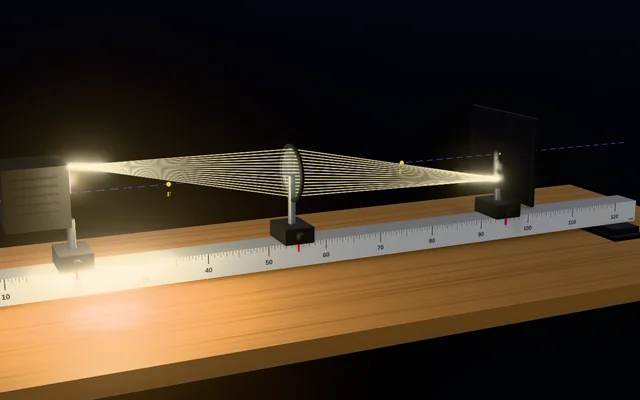
Lenses and mirrors
Slide the lens and watch an image form on the screen. Converging and diverging lenses, concave and convex mirrors, ray paths.
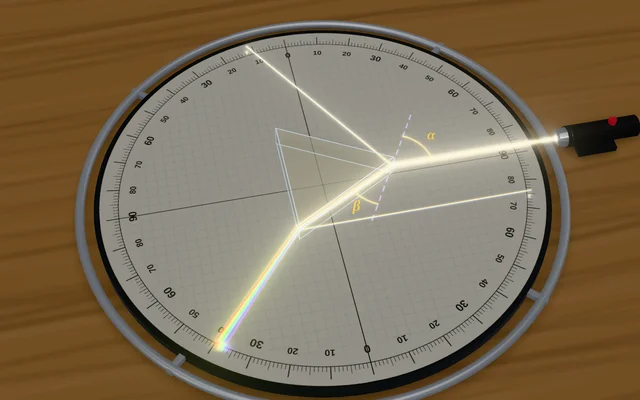
Refraction of light
Aim a laser at water, glass and diamond. Snell's law, total internal reflection and a rainbow from a prism.
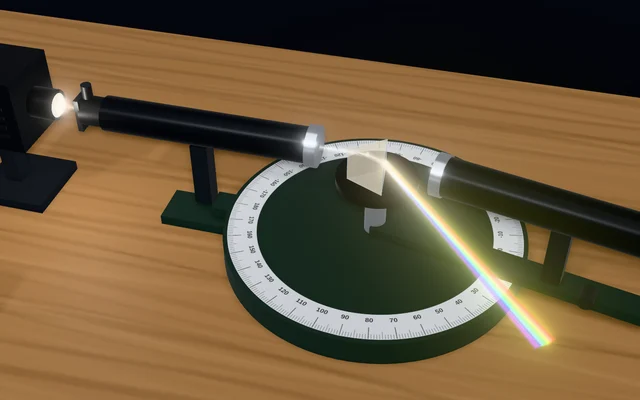
Prism and dispersion
A prism splits white light into a spectrum. Measure the glass’s refractive index from minimum deviation, and n(λ).
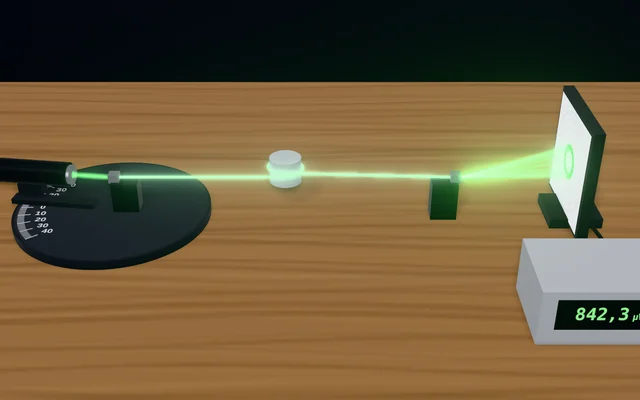
Optical fibre
Total internal reflection and optical fibres: measure the critical angle, a fibre’s numerical aperture and its bending loss.
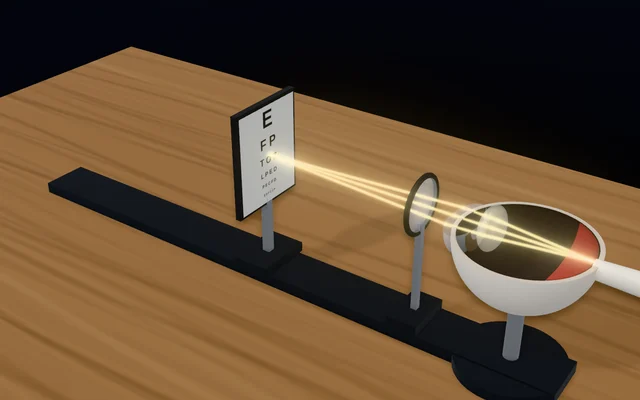
The eye and optical instruments
How the eye sees: accommodation, near and far points, correcting myopia and hyperopia with glasses, and the magnifier.
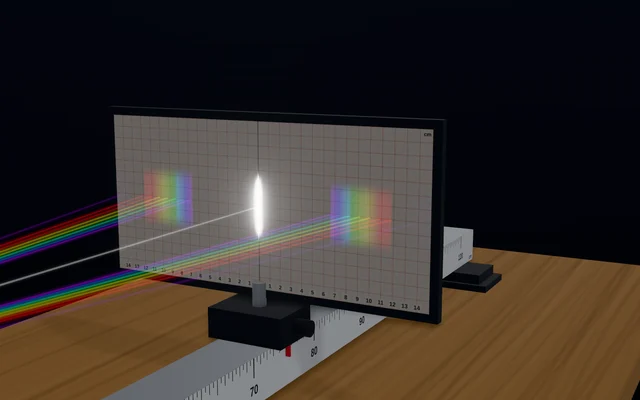
Interference
A laser beam through two slits paints bright and dark fringes on a screen. Young's experiment, a diffraction grating and measuring the wavelength.
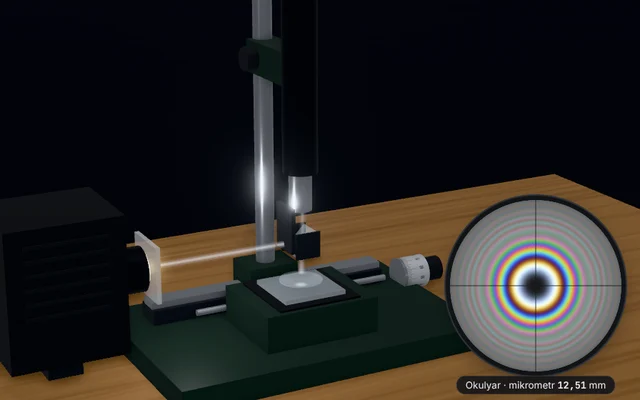
Newton's rings
Bright and dark rings in the thin air layer under a lens. Measure their diameters with a measuring microscope and find the lens's radius of curvature.
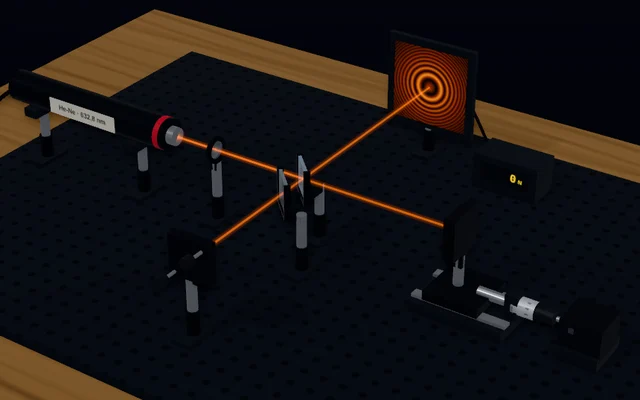
Michelson interferometer
A beam is split and recombined into rings on a screen. Moving a mirror by λ/2 brings out one ring. Count fringes to measure λ, a gas's n and Δλ.
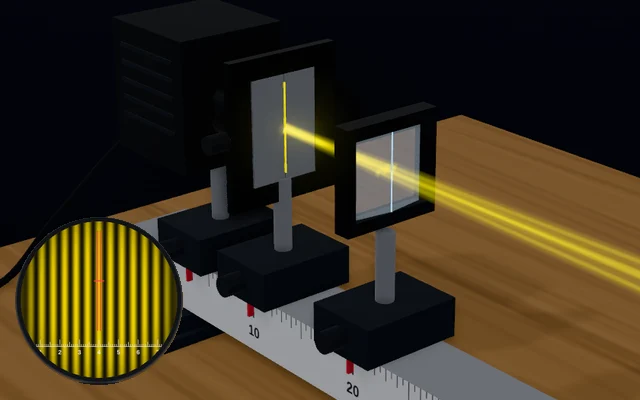
Fresnel's biprism
A biprism makes two coherent sources from one slit: fringes in the eyepiece. Use Δx = λL/d and d = √(d₁d₂) to measure λ. Lloyd's mirror too.
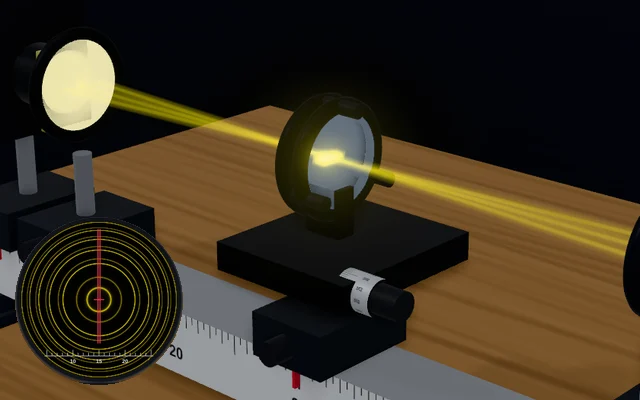
Fabry–Pérot interferometer
Light bounces many times between two parallel mirrors, giving thin bright rings. Raise R, resolve the sodium doublet and measure the etalon gap.
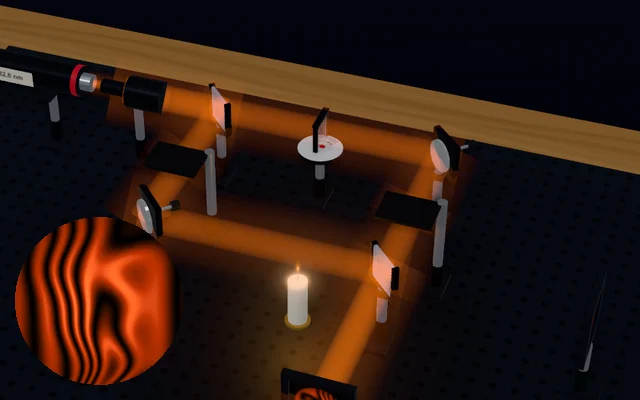
Mach–Zehnder interferometer
Light travels two separate arms and recombines; the two screens complement each other. See a candle's hot air and single-photon interference.
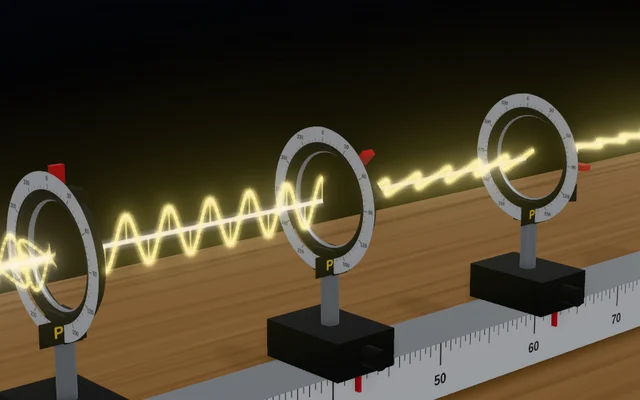
Polarization
Light dims and returns between two polaroids. Malus's law, the third-polaroid paradox and Brewster's angle, with the electric field wave shown.
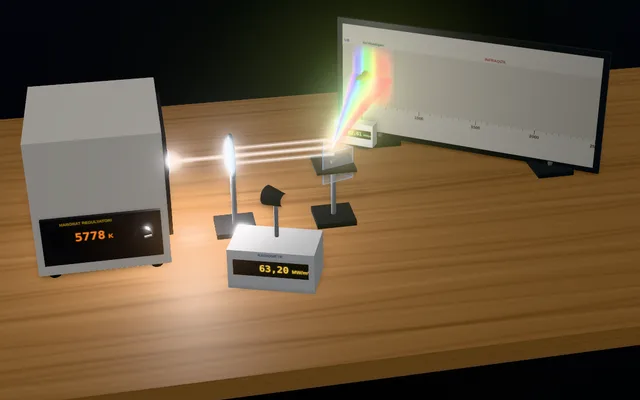
Thermal radiation
Heat the furnace and its colour shifts from red to white. The black-body spectrum, the Planck curve and Wien's law.
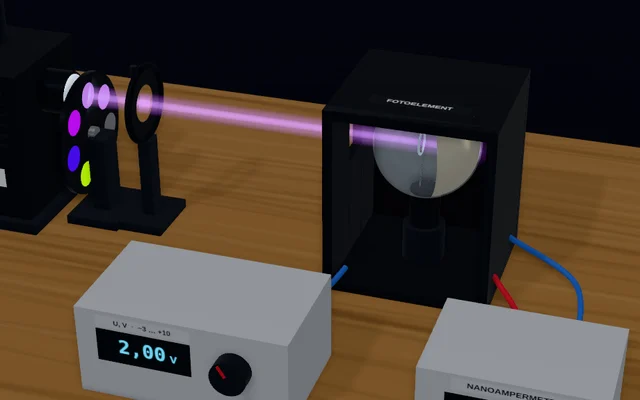
Photoelectric effect
Light knocks electrons out of a metal: hν = A + Eₖ. Measure the stopping voltage to find Planck's constant and the work function. The red limit.
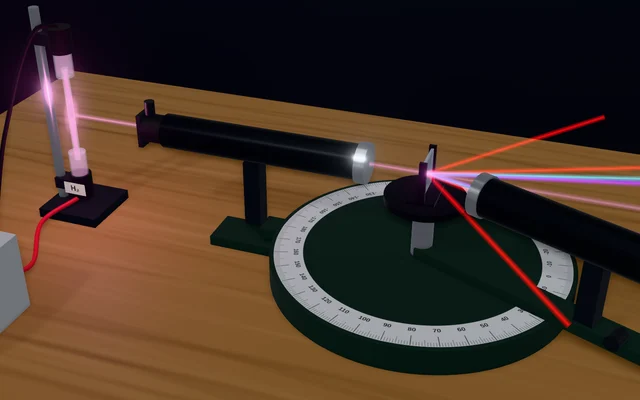
Atomic spectra
Gas line spectra, a diffraction-grating spectrometer, the hydrogen Balmer series, the Bohr model and measuring the Rydberg constant.