The brightest supernova ever seen — SN 2016aps
The study was published on 13 April 2020 in Nature Astronomy. The explosion was spotted in February 2016 by the Pan-STARRS telescope in Hawaii.
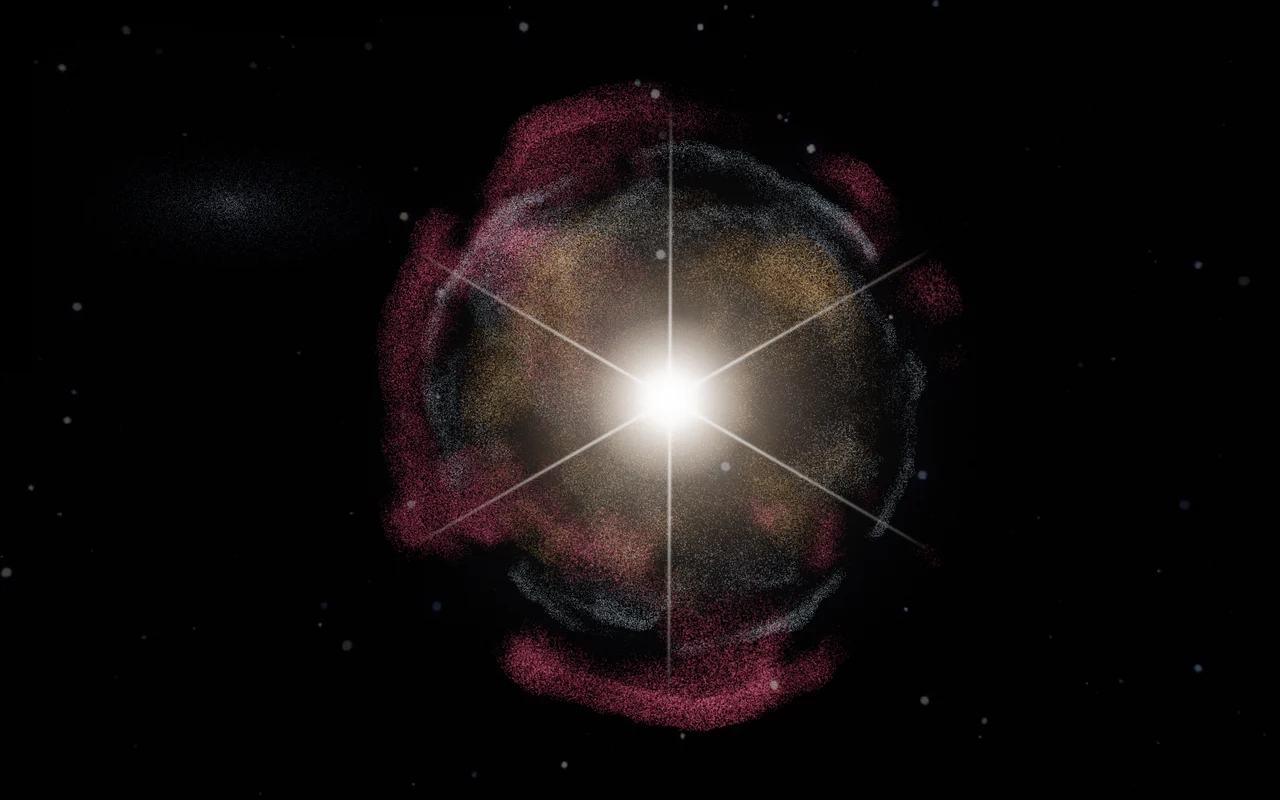
Image: Virtual Lab (3D illustration)
A supernova is the explosion of a massive star at the end of its life, briefly outshining a whole galaxy. Even among these, SN 2016aps proved to be a record-breaker.
A team led by Matt Nicholl of the University of Birmingham followed the explosion for two years until it faded to 1% of its peak. From its spectrum and light curve they estimated the star held 50–100 times the mass of the Sun.
The team thinks it was a rare 'pulsational pair-instability' supernova. Before dying, such a giant star 'hiccups' several times, shedding outer shells; the final blast then catches up and slams into them, and the collision releases enormous amounts of light.
The star may have formed from the merger of two large stars, as the abundance of hydrogen suggests. Such explosions had existed only in theory; SN 2016aps may be the first convincing example.
 Try it in the labThermal radiation3D lab on this site →Share on Telegram
Sources: Nature Astronomy (DOI) · Space.com