The universe's 'missing' ordinary matter is found using radio bursts
The results were published on 27 May 2020 in Nature; the study was led by Jean-Pierre Macquart.
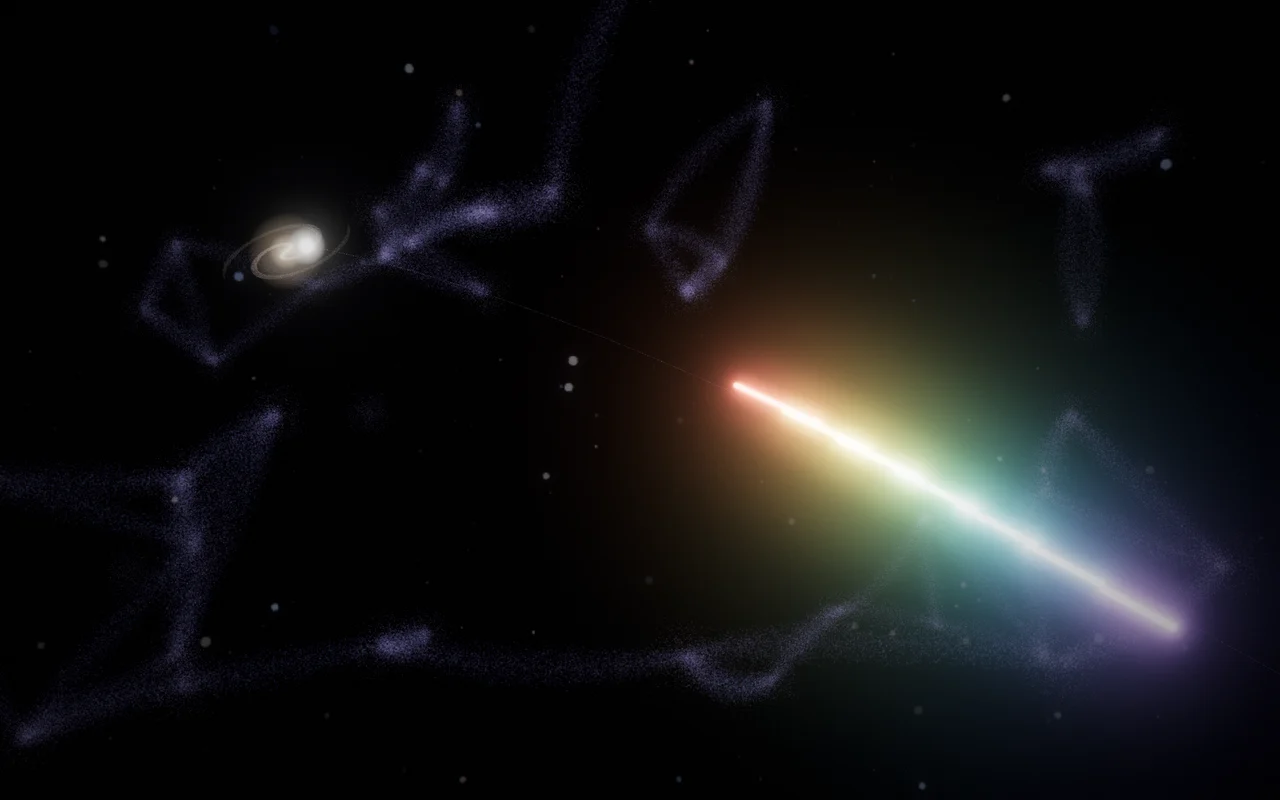
Image: Virtual Lab (3D illustration)
Everything around us — stars, planets, people — is made of protons and neutrons, which scientists call baryons. The universe's first light and the amounts of the lightest elements tell us exactly how many there should be, yet for 30 years half were missing.
They were thought to hide in gas between galaxies, but that gas is so thin that an ordinary room's worth holds only one or two atoms. It barely glows, so telescopes cannot see it.
Fast radio bursts provided the answer. As a burst passes through gas, longer waves arrive slightly later than shorter ones, much as a prism bends colours differently. The delay depends on the number of free electrons along the way, so it can be used to 'weigh' the matter in between.
The 36-antenna ASKAP radio telescope in Western Australia pinned several bursts to their home galaxies. Knowing the distances, the team calculated the amount of gas along each path — and the total matched theory exactly. The missing matter had been found.
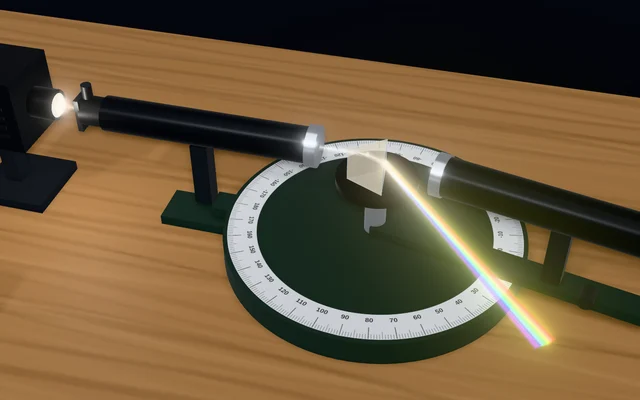 Try it in the labPrism and dispersion3D lab on this site →Share on Telegram
Sources: Nature (DOI) · University of Washington