A time crystal created on Google's quantum computer
The result was published in Nature on 30 November 2021.
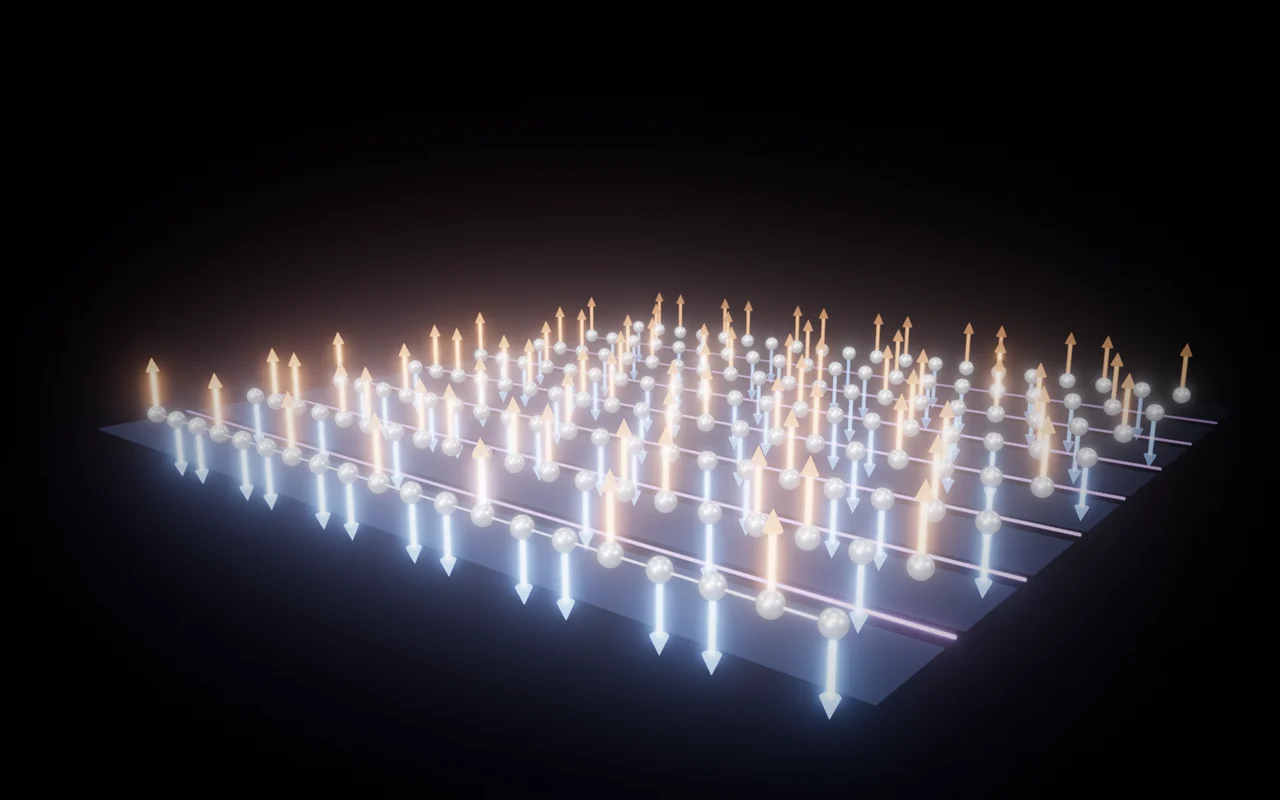
Image: Virtual Lab (3D illustration)
In ordinary crystals, atoms repeat in space, as in table salt. In 2012 Nobel laureate Frank Wilczek asked whether a 'crystal' could repeat in time — a perpetual motion costing no energy.
That turned out to be impossible for a system in equilibrium, but not for one driven by periodic pushes. Qubits can flip with each push yet return to their starting state only every two pushes — and crucially, the rhythm survives even if the pushes are slightly imperfect, without the system heating up.
The Google team linked 20 Sycamore qubits in a chain, tuning their interactions so energy could not spread freely between them. They then 'kicked' the qubits hundreds of times in a row and watched them switch steadily at half the rhythm of the kicks.
They also checked that this held for any starting state and wasn't caused by outside noise, so the work is regarded as a convincing demonstration of a time crystal. Here the quantum computer served not as a calculator but as a laboratory for new physics.
 Try it in the labSimple pendulum3D lab on this site →Share on Telegram
Sources: Nature (DOI) · Wikipedia