Hubble measures the largest comet nucleus known: 129 km across
The result appeared in The Astrophysical Journal Letters on 12 April 2022, in work led by Man-To Hui.
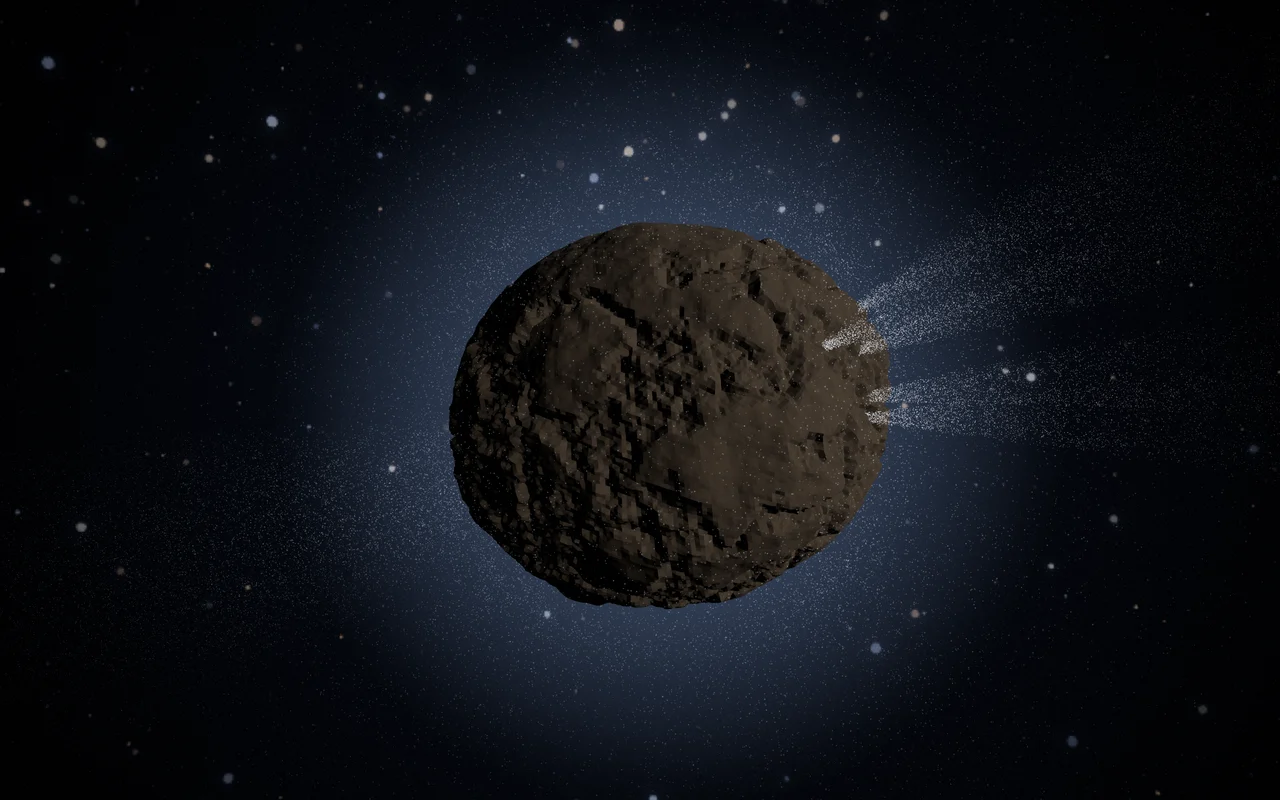
Image: Virtual Lab (3D illustration)
Astronomers Pedro Bernardinelli and Gary Bernstein found the comet in 2021 among old images taken to study dark energy. It is falling in from the Oort Cloud at the far edge of the solar system, thought to hold trillions of icy bodies.
Measuring a comet's nucleus is hard because a bright 'coma' of dust and gas surrounds it. Hubble took five images; using a computer model, the team subtracted the coma's glow to isolate the light from the nucleus, then worked out its size from how much light it reflects and how dark it is.
The previous record holder, comet C/2002 VQ94, had a nucleus about 96 kilometres wide. The new comet's nucleus is blacker than coal, reflecting very little of the light that falls on it. It is heading towards the Sun at 35,000 kilometres per hour.
It will make its closest approach in 2031 but never come closer than Saturn's orbit, so it poses no danger to Earth and will not be visible to the naked eye. One orbit takes about 3 million years. Co-author David Jewitt calls it 'the tip of the iceberg' for thousands of comets hidden in the outer solar system.
 Try it in the labThermal radiation3D lab on this site →Share on Telegram
Sources: NASA Hubble · ApJ Letters (DOI)