IceCube detects neutrinos from the core of a nearby active galaxy
Published in Science on 3 November 2022, the result drew on data from 2011 to 2020.
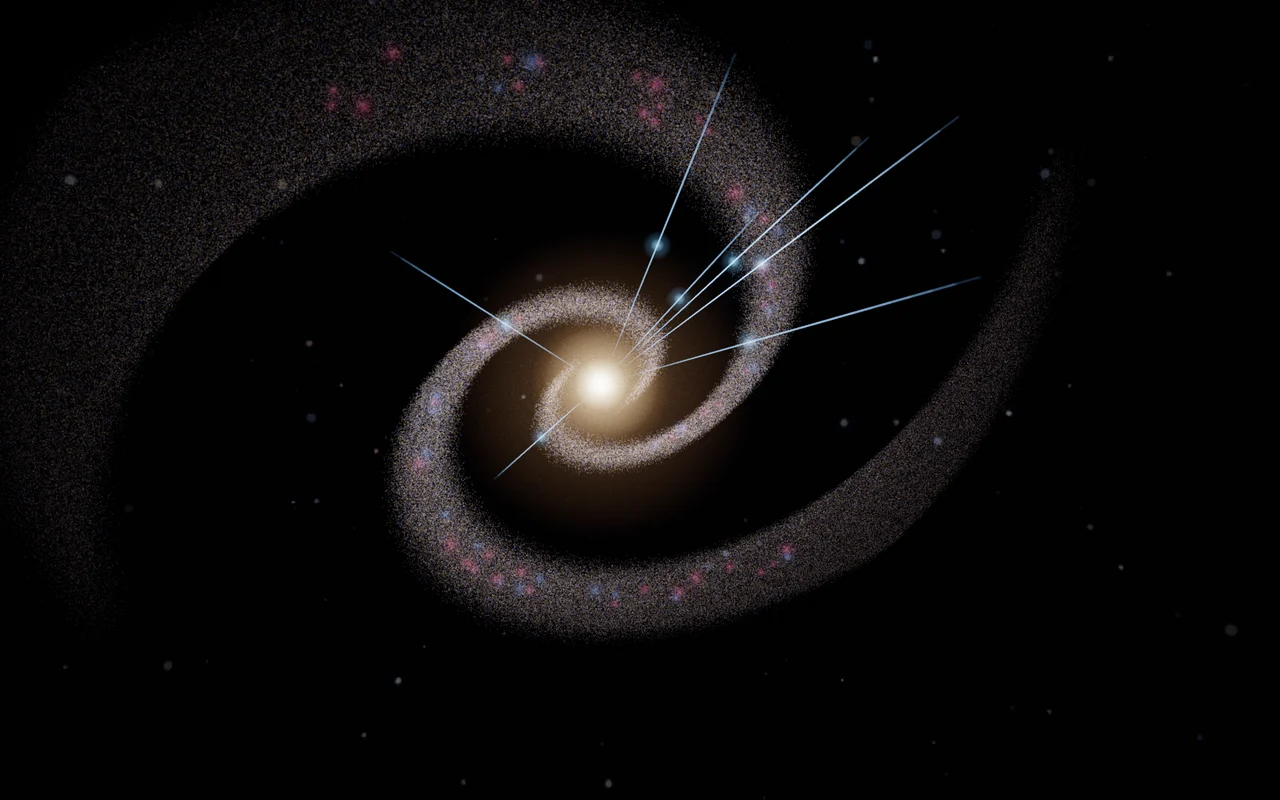
Image: Virtual Lab (3D illustration)
The neutrino is a neutral, almost massless particle that barely interacts with matter. Billions pass through our bodies every second unnoticed. So they travel in straight lines through galaxies and dust clouds unhindered, carrying information about where they were born.
IceCube sits at the South Pole, 1.5–2.5 km deep in the ice, where more than 5,000 light sensors watch a cubic kilometre of ice. Occasionally a neutrino hits an atom and produces a very fast charged particle that outruns light's speed in ice, giving off a bluish Cherenkov glow that the sensors record.
NGC 1068 (M77) lies 47 million light years away in the constellation Cetus. Its central black hole is wrapped in thick dust, so high-energy gamma rays cannot escape while neutrinos can. Indeed, the neutrino flux turned out at least 10 times stronger than the gamma-ray flux.
The signal's significance is 4.2 standard deviations — a little short of the 5 needed for a discovery, but very strong evidence. In 2018 IceCube found the first neutrino source, the distant blazar TXS 0506+056; NGC 1068 is the second, and here the neutrinos come as a steady stream rather than a single flare.
 Try it in the labRefraction of light3D lab on this site →Share on Telegram
Sources: Science (DOI) · Physics World