First evidence of a rare Higgs boson decay
The result was presented on 25 May 2023 at the LHCP conference in Belgrade and later published in Physical Review Letters.
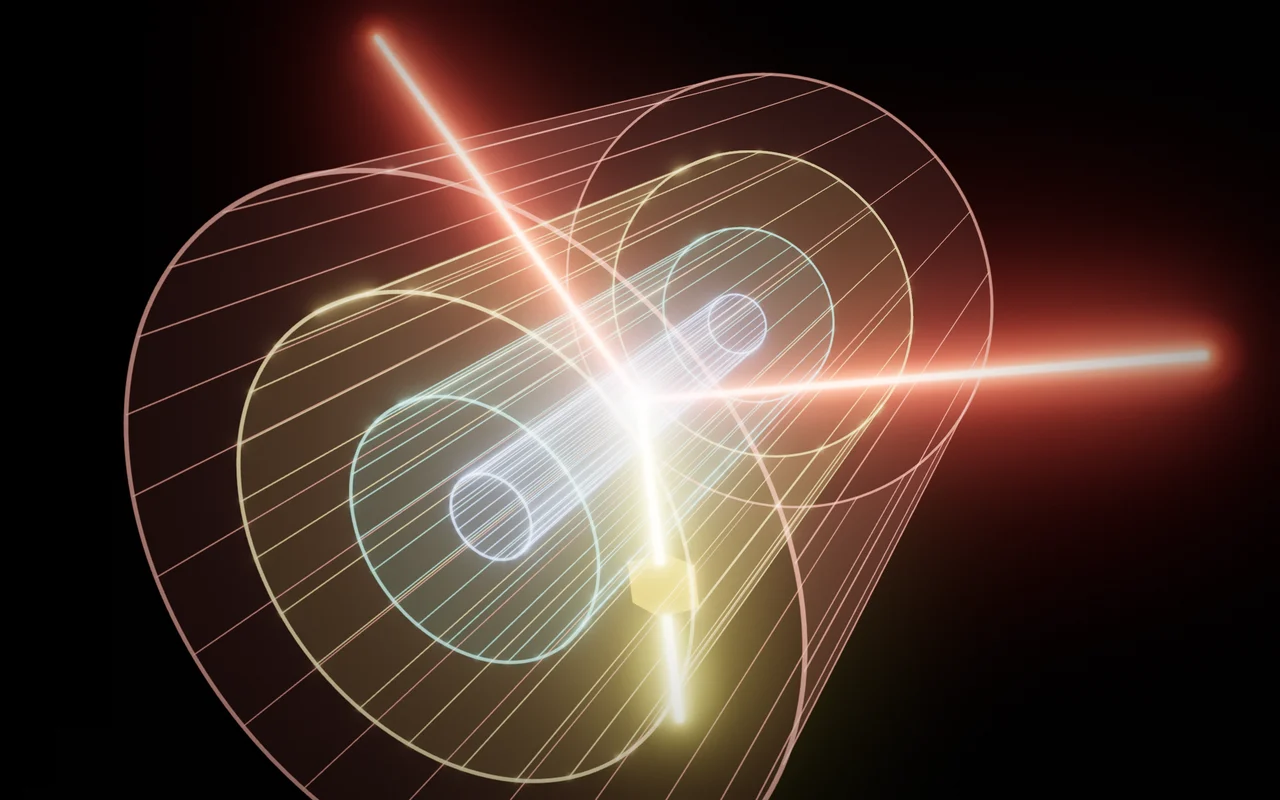
Image: Virtual Lab (3D illustration)
The Higgs boson was discovered in 2012. It is tied to the Higgs field, which gives other elementary particles their mass, and physicists have since been measuring in detail how it 'talks' to each particle. So far everything agrees with the Standard Model.
The Higgs decays almost instantly into other particles. Decay into a Z boson and a photon is very rare and proceeds not directly but through a loop of 'virtual' particles. If unknown particles join the loop, the decay rate changes — which makes it highly sensitive to new physics.
The search used Z bosons decaying into pairs of electrons or muons, which happens in only 6.6% of cases. From the energies and momenta of the pair and the photon, the mass of the parent particle was reconstructed, and a small bump appeared near 125 GeV.
Combining data from 2015–2018, the signal reached 3.4 standard deviations — 'evidence' level, short of the 5 needed for a discovery. The measured rate came out 2.2 ± 0.7 times the prediction, not yet clearly different from the Standard Model.
 Try it in the labMass spectrometer3D lab on this site →Share on Telegram
Sources: CMS · Physical Review Letters (DOI)