The universe's gravitational hum: a wave background found with pulsars
The NANOGrav collaboration announced the result on 28 June 2023 in The Astrophysical Journal Letters; groups in Europe, Australia, India and China reported similar findings the same day.
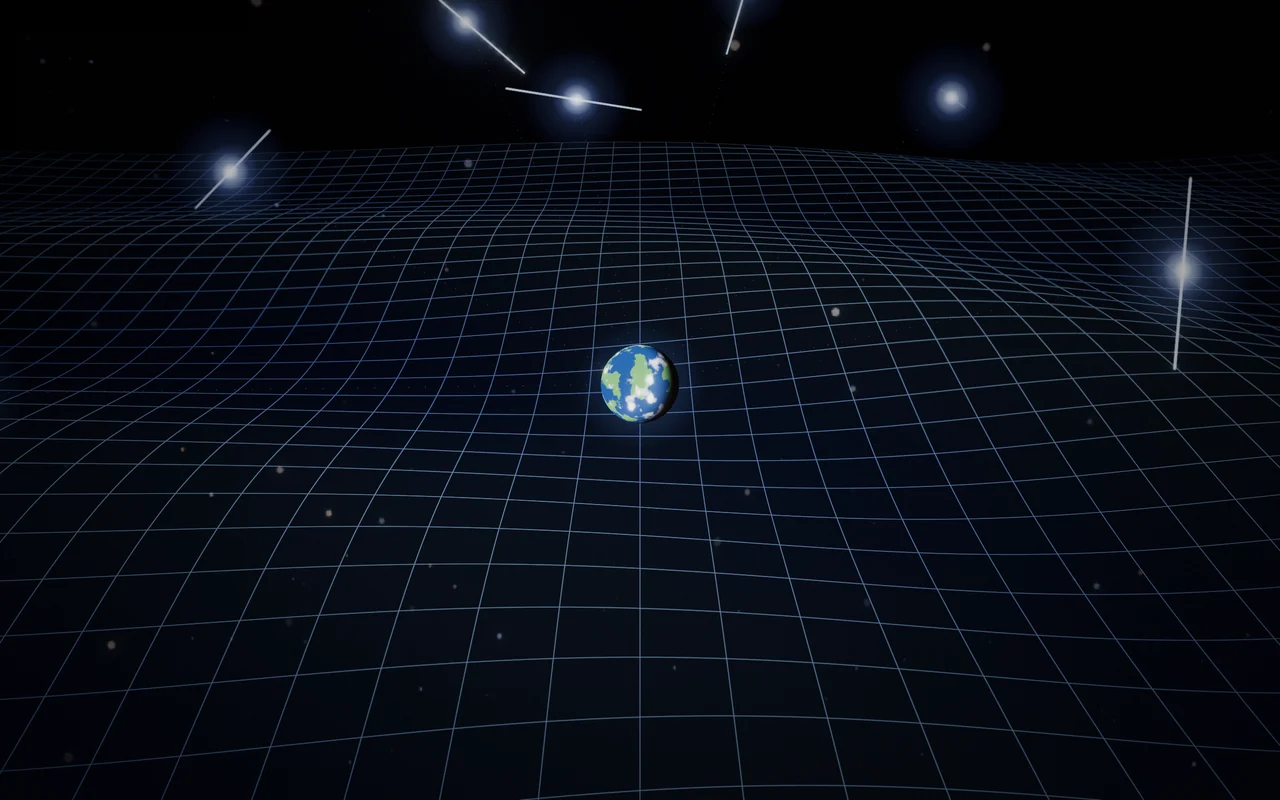
Image: Virtual Lab (3D illustration)
Gravitational waves are ripples in spacetime, first detected by LIGO in 2015. LIGO 'hears' stellar-mass black holes that spiral together in seconds. Pairs of supermassive black holes orbit far more slowly, and their waves take years or decades to complete one cycle — nanohertz frequencies.
Catching such enormous waves requires an antenna the size of a galaxy. Millisecond pulsars — rapidly spinning neutron stars that flash radio pulses like lighthouses, so regularly that they rival the best clocks — play that role.
A passing gravitational wave slightly stretches and squeezes the distance between Earth and a pulsar, so its pulses arrive early or late by tens to hundreds of nanoseconds. After timing 67 pulsars for 15 years, NANOGrav found that their timing shifts are correlated.
Crucially, the correlation depends on the angle between pulsars on the sky in a special way — the Hellings–Downs curve, predicted for gravitational waves in 1983. That pattern is the fingerprint pointing to a gravitational-wave origin.
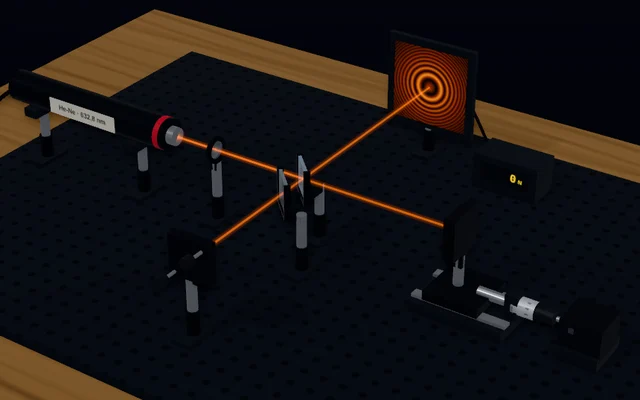 Try it in the labMichelson interferometer3D lab on this site →Share on Telegram
Sources: arXiv (NANOGrav) · UC Berkeley