The first working graphene semiconductor is made
Researchers at Georgia Tech and Tianjin University published the work in Nature in early January 2024.
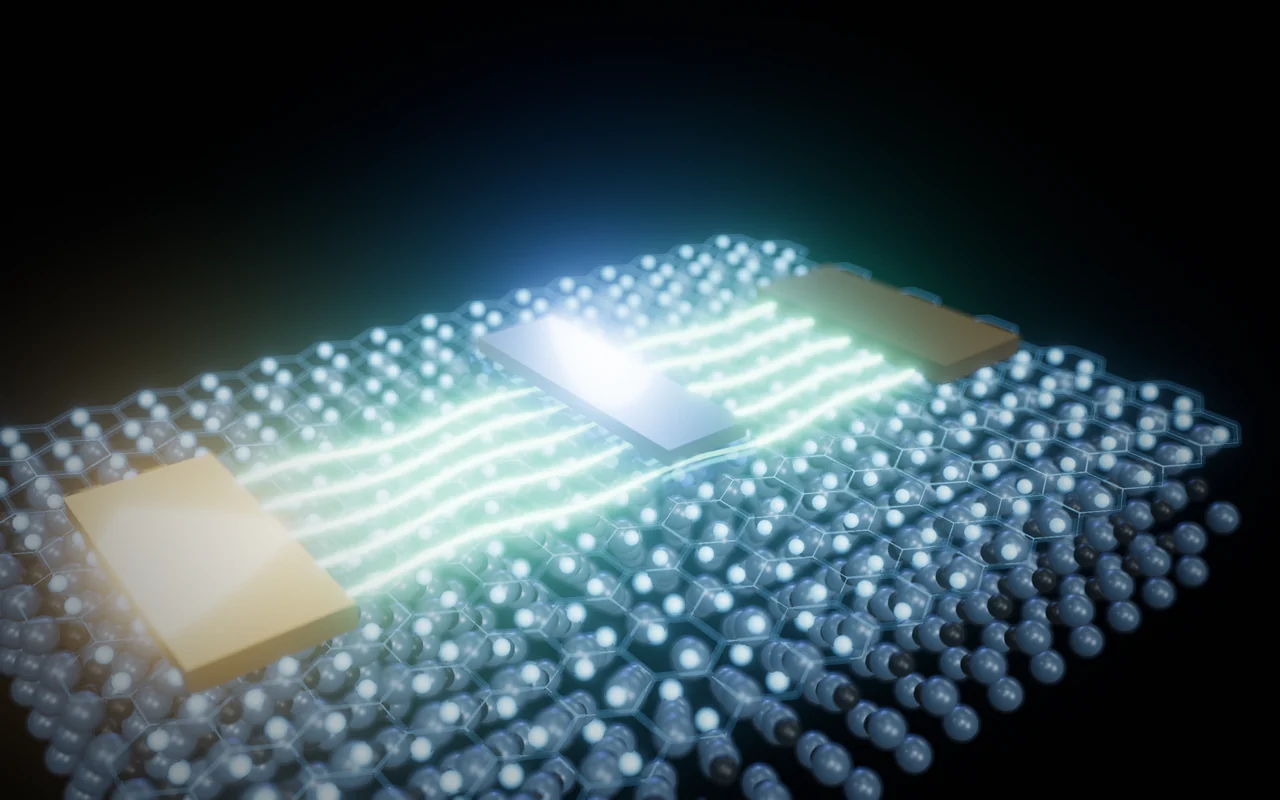
Image: Virtual Lab (3D illustration)
Every transistor in a computer is a tiny switch that either lets current through (1) or blocks it (0). That requires a semiconductor with a 'band gap'. Silicon has one, which is why it has been the backbone of electronics for 60 years.
Graphene is a sheet of carbon one atom thick. Electrons race through it, but it has no band gap: it always conducts and cannot be switched off. Two decades of attempts to open a gap had failed.
Walt de Heer's team heated silicon carbide crystals. Silicon evaporates from the surface, and the remaining carbon forms an ordered graphene layer chemically bonded to the crystal. A new annealing method let this layer grow over large, atomically flat terraces.
The resulting 'epigraphene' has a band gap of 0.6 electronvolts. Its room-temperature electron mobility exceeds 5,000 cm²/(V·s) — ten times that of silicon and twenty times that of other 2D semiconductors. The material is robust and compatible with standard chip-making techniques.
 Try it in the labThe transistor3D lab on this site →Share on Telegram
Sources: Nature (DOI) · TechSpot