Webb finds the most distant galaxy: 290 million years after the Big Bang
Scientists from the JADES programme announced the result on 30 May 2024; ESA and NASA confirmed the discovery.
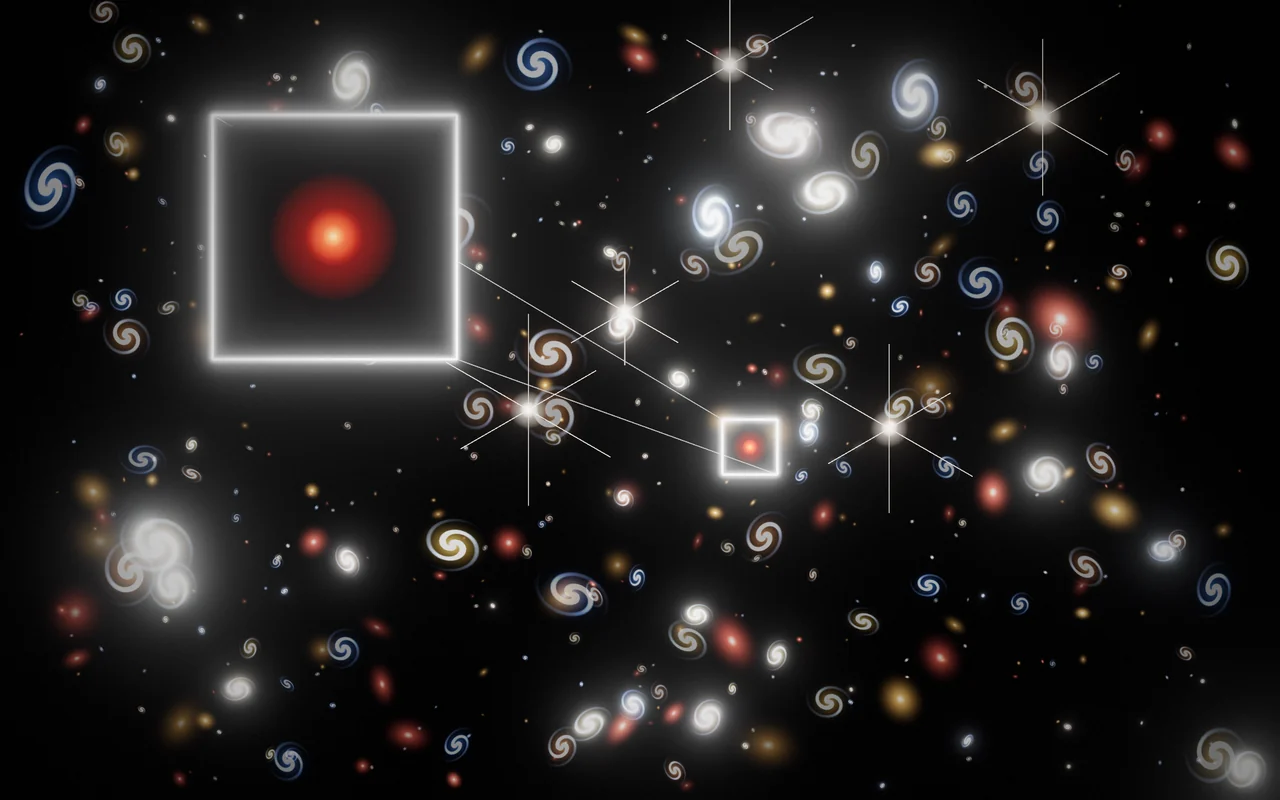
Image: Virtual Lab (3D illustration)
Looking at distant galaxies means looking into the past: we see them as they were when their light set out. As the universe expands, that light's waves are stretched and its spectrum shifts towards red. This is called redshift — the bigger it is, the farther and older the galaxy.
JADES-GS-z14-0 has a redshift of 14.32, meaning we see it when the universe was only 2% of its current age. The previous record-holder dated from 325 million years after the Big Bang.
The galaxy lies in the direction of the constellation Fornax and is about 1,600 light years across. Webb's NIRSpec spectrograph split its light and pinned down its distance; later, the ALMA radio telescopes detected oxygen in it.
That is surprising: oxygen is forged inside stars and spread when they explode, so several generations of stars must already have lived and died there. Astronomers are trying to understand why the first galaxies grew so much faster than expected.
 Try it in the labThe Doppler effect3D lab on this site →Share on Telegram