A single nuclear decay detected by its recoil
The study, led by David Moore and Jiaxiang Wang, was published in Physical Review Letters in July 2024.

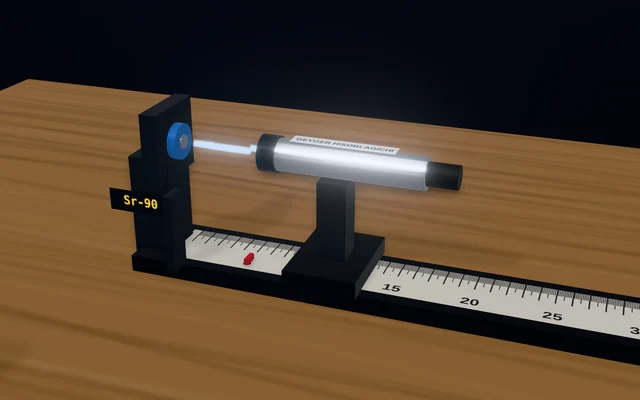
Image: Virtual Lab (3D illustration)
Throw a ball forward while standing on a skateboard and you roll backward — Newton's third law, or conservation of momentum. Yale scientists took this simple idea down to the level of a single atomic nucleus.
They embedded radioactive lead-212 atoms in silica (glass) beads just 3 microns across. Each bead was held in vacuum by a focused laser beam and cooled to suppress its jiggling.
When a nucleus inside decays and an alpha particle (a helium nucleus) escapes, the bead 'jumps' about 10 nanometres in the opposite direction. The laser tracks the bead so precisely that each jump can be seen individually.
The team thus timed each decay without catching the alpha particle at all — just from the bead's recoil. The set-up fits on a couple of lab benches and is far cheaper than giant detectors.
 Try it in the labRadioactivity3D lab on this site →Share on Telegram
Sources: Physics Today · arXiv