CERN creates the first antimatter qubit
On 23 July the BASE collaboration published its paper in Nature.
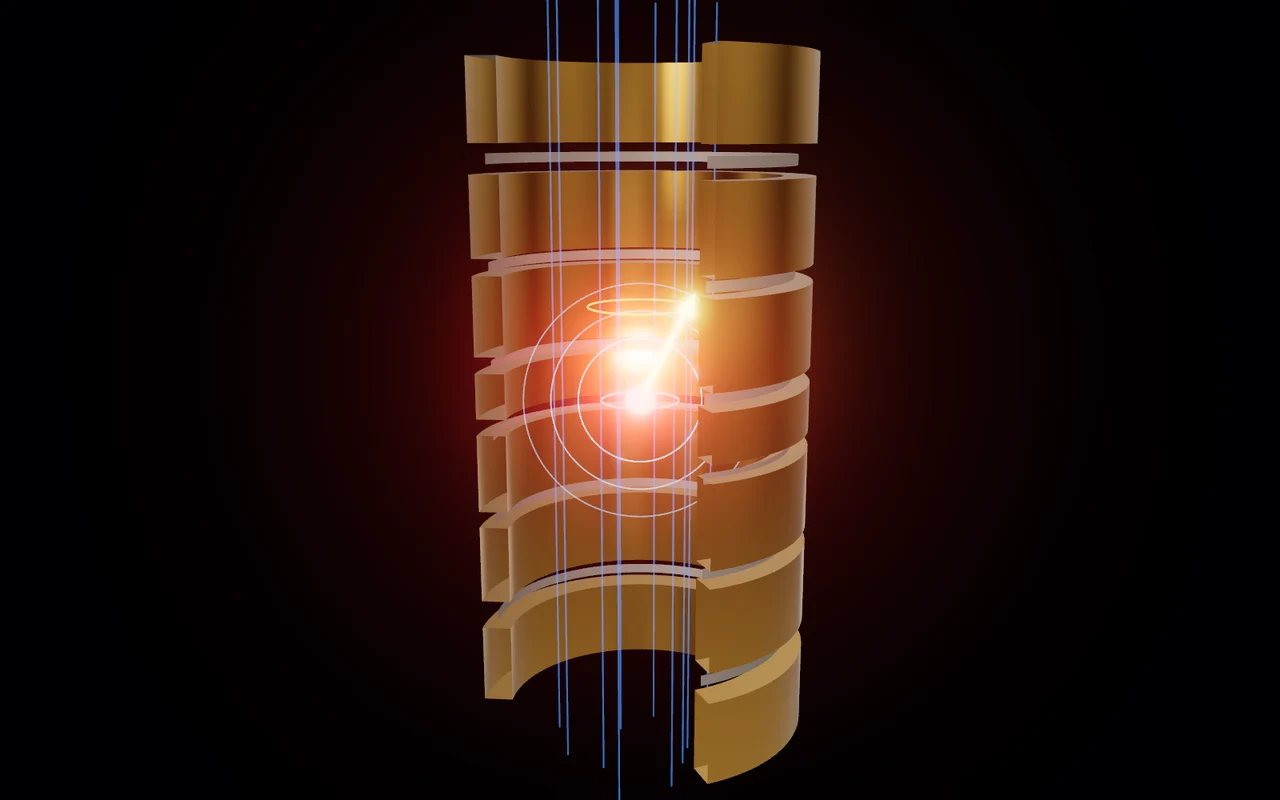
Image: Virtual Lab (3D illustration)
An antiproton is the proton's twin in the world of antimatter: the same mass but a negative charge. Like the proton it behaves as a tiny magnet because it has spin, which can point either “up” or “down”. Antimatter vanishes as soon as it meets ordinary matter, which makes it very hard to study.
BASE works at CERN's antimatter factory. Antiprotons are held in Penning traps, strong magnetic and electric fields in a vacuum. One of them is then moved into a separate trap where its spin is controlled with radio waves.
The team managed to swing the spin smoothly between “up” and “down”, like a swing pushed at just the right moments, and kept this coherent state going for about 50 seconds. In quantum terms, this is a qubit made from the spin of a single antiproton. Such controlled quantum transitions had never before been seen in an antimatter particle.
The qubit is not meant for a quantum computer. Its main job is to measure the antiproton's magnetic moment 10 to 100 times more precisely than before. Next, antiprotons will be carried in a transportable trap called BASE-STEP to a quieter laboratory.
 Try it in the labMagnetic field3D lab on this site →Share on Telegram
Sources: HHU Düsseldorf · MPI für Kernphysik