Clearest signal yet: black holes confirm Hawking's theorem
On 10 September the LIGO–Virgo–KAGRA collaboration published its analysis of the GW250114 signal.
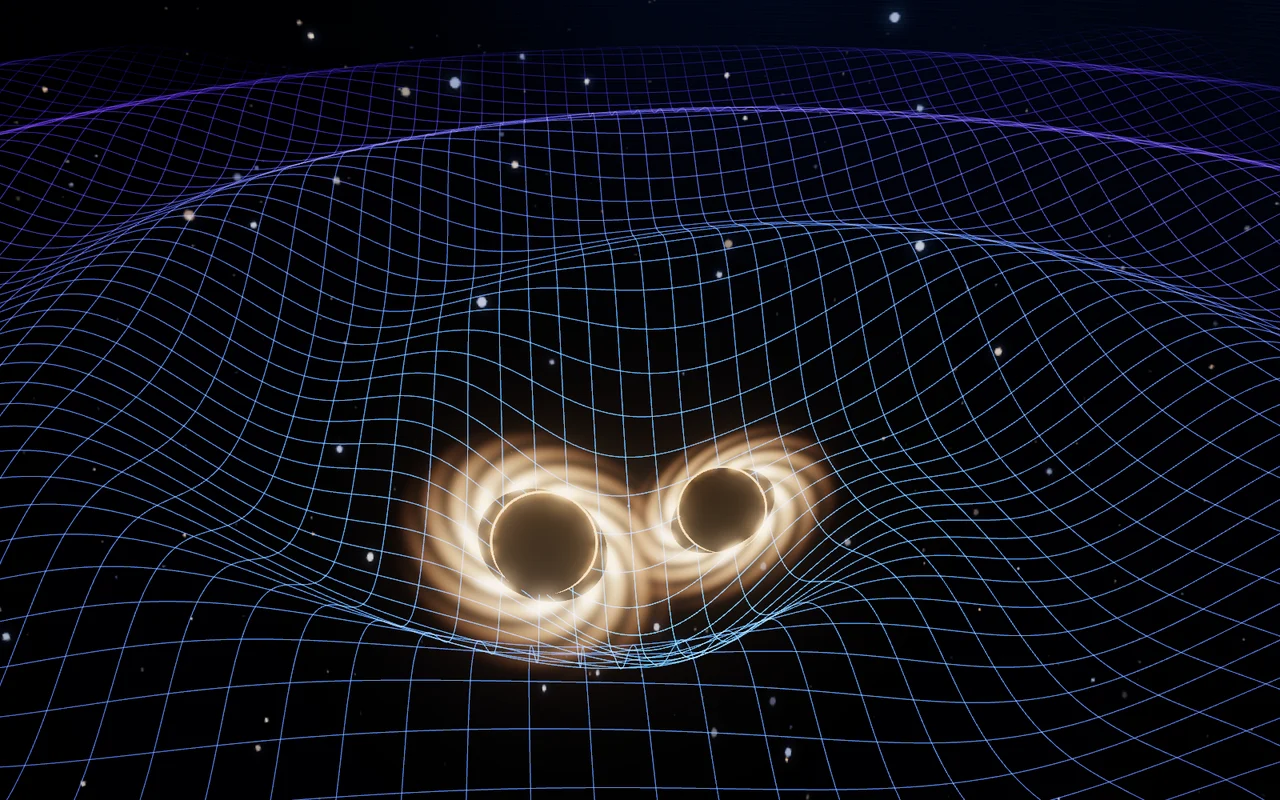
Image: Virtual Lab (3D illustration)
Gravitational waves are ripples in space-time sent out when massive bodies move quickly. Einstein predicted them in 1916, and LIGO first detected them on 14 September 2015. LIGO is a giant laser interferometer with 4-kilometre arms that can sense a change in arm length thousands of times smaller than a proton.
On 14 January 2025 LIGO caught a signal from two black holes merging about 1.3 billion light-years away, with masses about 33.6 and 32.2 times the Sun's. Thanks to a decade of upgrades, the signal stood 80 times above the noise, the clearest ever recorded.
In 1971 Stephen Hawking showed that when black holes merge, the total area of their event horizons cannot decrease. Here, the two horizons before the merger had a combined area of about 240,000 square kilometres, the size of the UK, while the single black hole afterwards had about 400,000 square kilometres, the size of Sweden.
The new black hole “rang” like a bell, and the frequencies of its waves matched Roy Kerr's 1963 solution for a spinning black hole. The first test in 2021 gave 95% confidence; now it has reached 99.999%.
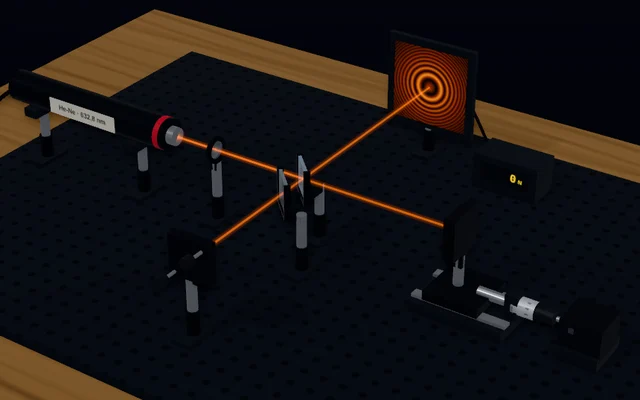 Try it in the labMichelson interferometer3D lab on this site →Share on Telegram