Breakthrough of the Year: metal just one atom thick
On 18 December Physics World announced its 2025 Breakthrough of the Year.
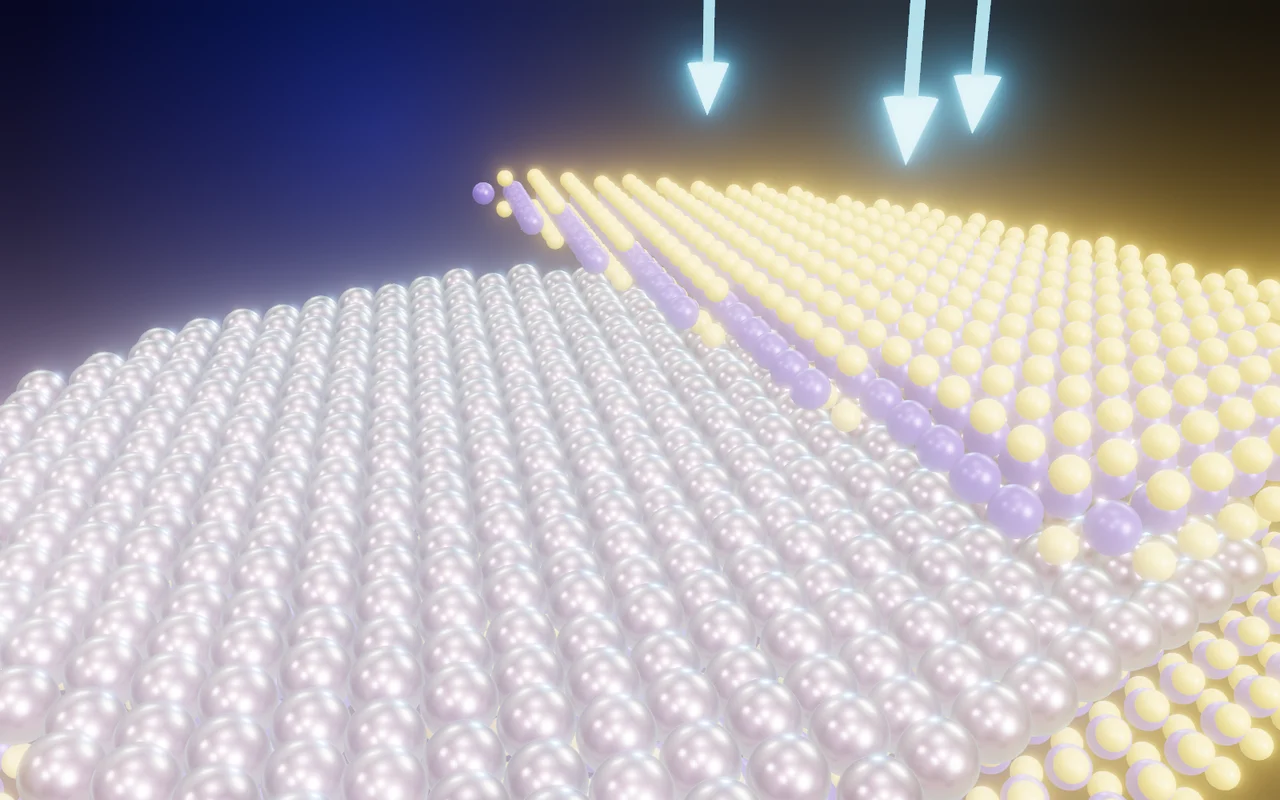
Image: Virtual Lab (3D illustration)
Since graphene, a sheet of carbon one atom thick, was made in 2004, hundreds of two-dimensional (2D) materials have followed. In most of them the atomic layers are only weakly bound, so peeling off a single layer is easy. In metals, though, every atom is strongly bonded to its neighbours in all directions, and many thought atom-thin metals were impossible.
Guangyu Zhang, Luojun Du and colleagues at the Institute of Physics of the Chinese Academy of Sciences invented “van der Waals squeezing”. They melted pure metal powder and pressed the droplet between two “anvils” of single-layer molybdenum disulfide (MoS₂) on sapphire, which is atomically flat and does not react with the metal. A pressure of about 200 megapascals was held until the anvils cooled to room temperature.
This produced five 2D metals: bismuth, tin, lead, indium and gallium. The bismuth sheet is about 6.3 ångströms (0.63 nanometres) thick, a million times thinner than a sheet of A4 paper and 200,000 times thinner than a hair, while the sheets are more than 100 micrometres wide, far larger than other methods achieve.
The new metal sheets conduct electricity well and show a strong field effect and unusual quantum properties. The work was published in Nature in March 2025, and the authors say many other metals in the periodic table could be made this way.
 Try it in the labOhm's law3D lab on this site →Share on Telegram
Sources: Physics World · Physics World