A giant ten-sided wave appears at Saturn's south pole
The result was published in Science Advances on 2 September 2026, in work led by Agustín Sánchez-Lavega of the University of the Basque Country.
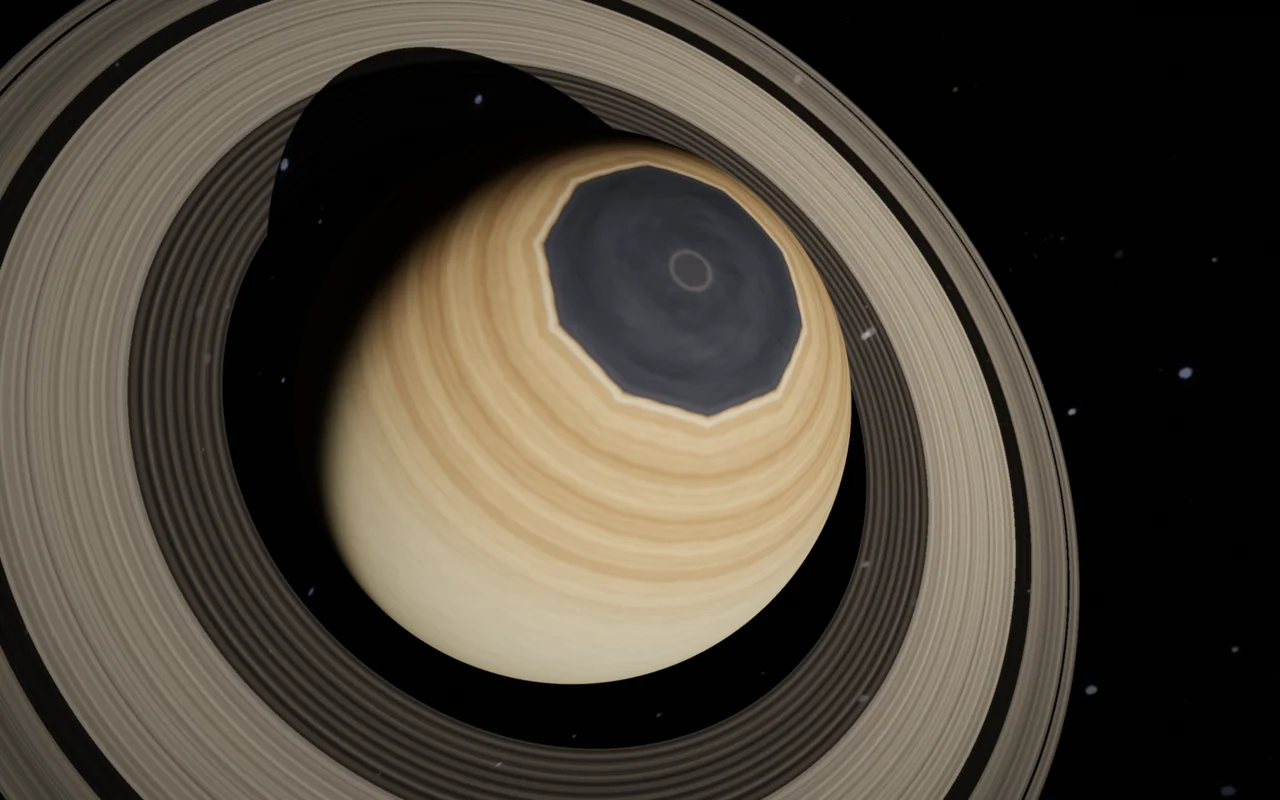
Image: Virtual Lab (3D illustration)
A giant hexagon has sat over Saturn's north pole for more than 40 years, seen ever since the Voyager flybys. Scientists long wondered whether the south hid a similar shape; the Cassini probe saw no long-lived polygon there between 2004 and 2017.
As the seasons turned and the south pole came back into view from Earth, images from 2024 showed a wavy, undulating band near it, spotted by Sánchez-Lavega and amateur astronomers Trevor Barry and Jean-Paul Oger. By 2025 the band had begun to look ten-sided.
A search of archival Hubble images from the OPAL programme then confirmed the decagon has existed since at least 2023, and images from 29 August 2025 show it clearly. It sits inside a powerful jet stream near 63° south latitude and extends through several layers of the atmosphere, which is why its position shifts slightly between filters.
Such polygons behave like a standing wave: only a whole number of waves fits around a circular jet — six in the north, ten in the south. The decagon resembles the hexagon but is distinctly different. 'The northern hexagon has been there every time we've looked for more than 40 years,' says NASA's Amy Simon. 'The most intriguing part to me is that this seems to have just formed recently.' How it formed and how long it will last remain open questions.
 Try it in the labStanding waves3D lab on this site →Share on Telegram
Sources: ESA/Hubble · NASA · Science Advances (DOI)