The first nuclear clocks are ticking
Two independent teams have reported clocks based on the thorium-229 nucleus in Nature.
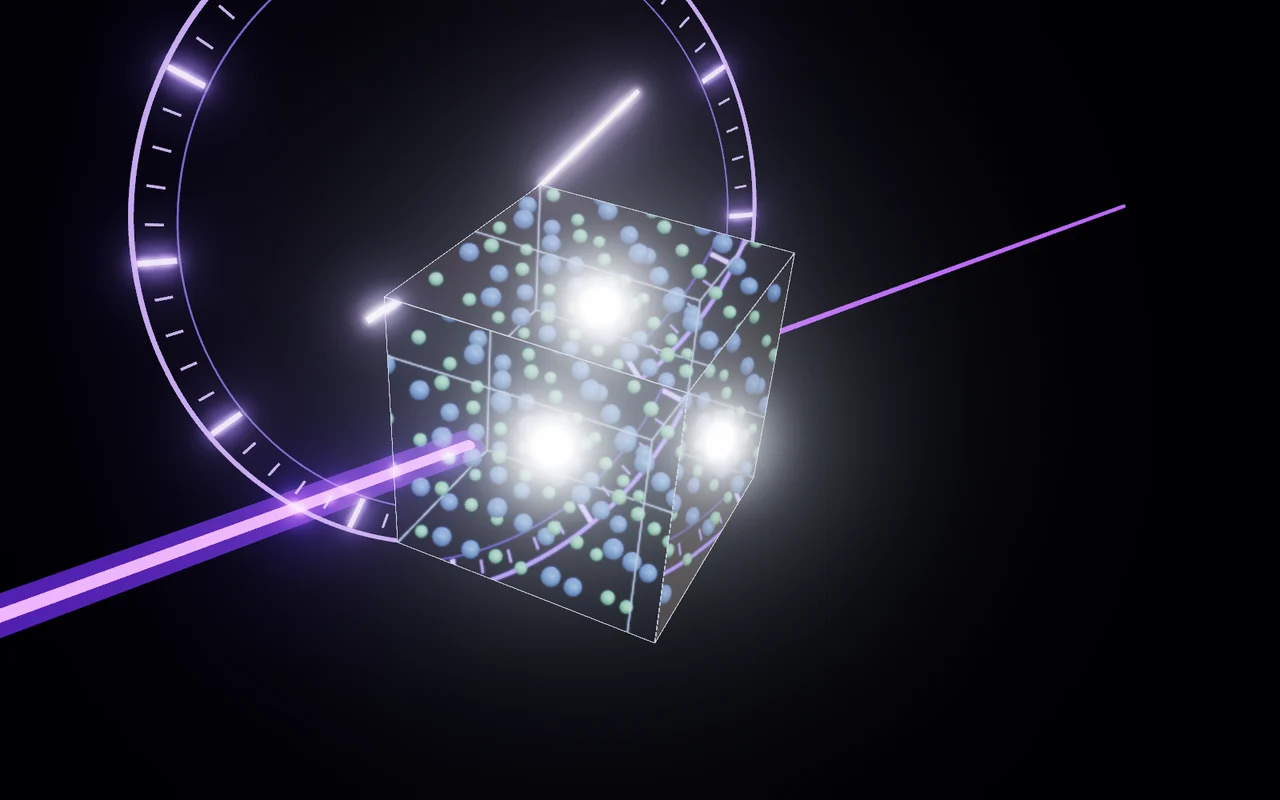
Image: Virtual Lab (3D illustration)
Today's most precise clocks are atomic clocks: they count the frequency of light emitted or absorbed when an electron jumps between energy levels in an atom. GPS, the internet and mobile networks all rely on them. But electrons sit in the outer part of the atom, so they feel outside electric and magnetic fields.
The nucleus is about 10,000 times smaller than the electron cloud and well shielded from outside influences. The problem is that exciting a nucleus usually needs gamma rays, which cannot be controlled like laser light. Thorium-229 is the exception: its excited state lies unusually low, at about 8.4 electronvolts, and can be reached with an ultraviolet laser.
Two teams, one from Germany's PTB and TU Wien (led by Ekkehard Peik and Thorsten Schumm) and one from Tsinghua University in Beijing (led by Shiqian Ding), placed thorium-229 atoms in millimetre-sized calcium fluoride crystals. An ultraviolet laser at 148.4 nanometres excites the nuclear transition, and a feedback loop locks the laser frequency to it, turning the nucleus into the clock's “pendulum”.
For now these clocks are not yet more precise than the best atomic clocks; experts call them the “first prototypes of nuclear clocks”. But the door is open. The PTB–Vienna team has already used its clock to search for ultralight dark matter, setting limits comparable to those from the best atomic clocks.
 Try it in the labAtomic spectra3D lab on this site →Share on Telegram
Sources: Physics World · American Nuclear Society