A giant star swallowed its companion — and astronomers watched it happen live
The result was published in Nature on 18 November 2026, in work led by Viraj Karambelkar of Columbia University, using the James Webb Space Telescope and many other observatories.
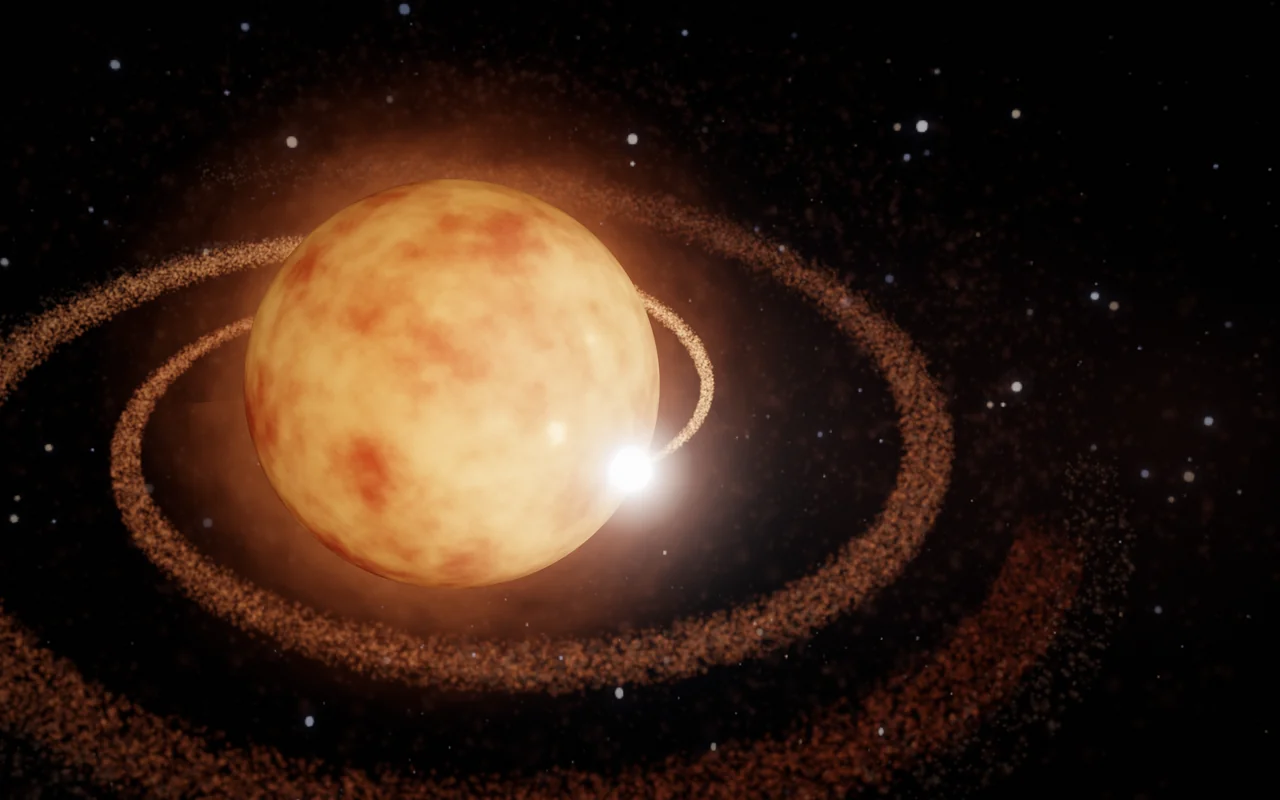
Image: Virtual Lab (3D illustration)
Most stars in the universe are not alone — they come in pairs, orbiting each other. Sometimes one star ages, swells enormously and engulfs its neighbour in its outer layers. Astronomers call this stage a 'common envelope'. The smaller star then moves through the giant's thin gas and, like a satellite dragged down by an atmosphere, spirals in towards the centre. The theory was known, but no one had ever watched it happen.
In the Andromeda galaxy, about 2.5 million light-years away, exactly this happened to a pair of stars called AT 2025abao — 'Bao' for short. The big star ('Big Bao') was 7 times as massive as the Sun, 350 times as wide and 18,000 times as bright — larger than Earth's orbit. Its companion ('Little Bao') had about 0.7 times the Sun's mass.
Several telescopes followed the process for years. In 2023 NEOWISE spotted odd changes in brightness; in 2024 the star began shedding dust; in July 2025 SPHEREx saw it fade in visible light while brightening in the infrared. Then on 17 October 2025 the Zwicky Transient Facility caught a powerful outburst that peaked within a week. On 24 December the James Webb Space Telescope studied the surrounding dust in mid-infrared light — the earliest such follow-up ever made.
Calculations show that once the smaller star reached the giant's surface, the two merged in just seven orbits — about seven years. Similar events seen before took thousands of orbits. What remains is a single, possibly 'rejuvenated' star. Astronomers will keep watching to confirm the merger conclusively and see how the star changes.
 Try it in the labArtificial satellite3D lab on this site →Share on Telegram
Sources: NASA · Sci.News · Nature (DOI)