Home › Nobel Prize laureates › 2006–2015 › 2014
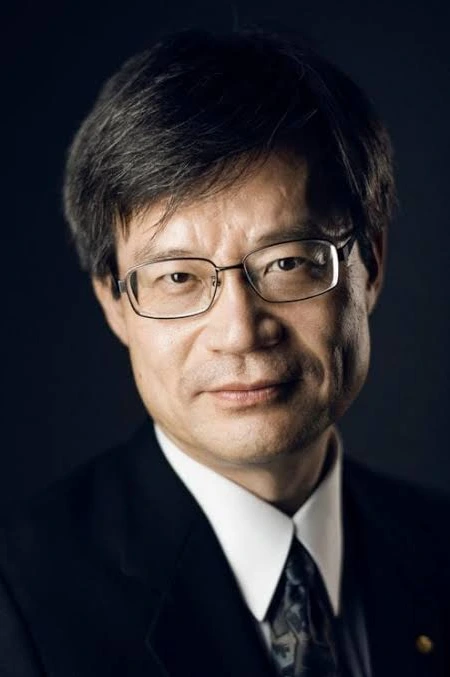
Hiroshi Amano
born 1960 · Japan
Prize motivation“for the invention of efficient blue light-emitting diodes which has enabled bright and energy-saving white light sources”
Shared the prize with: Isamu Akasaki, Shuji Nakamura
The discovery
A light-emitting diode (LED) is a tiny semiconductor crystal. When electrons meet “holes” inside it, the spare energy comes out as light, and the colour depends on the semiconductor's band gap. Red and green LEDs appeared in the 1950s and 1960s, but the blue LED defeated everyone for 30 years, and blue was exactly what was missing for white light.
Blue light needs a wide-band-gap semiconductor, gallium nitride (GaN), but growing good crystals of it and making a p-type (hole-rich) layer was very hard. In 1986 at Nagoya University, Akasaki and his doctoral student Amano grew the first high-quality GaN crystal by first laying a thin layer of aluminium nitride on a sapphire base. In 1989, by treating the crystal with an electron beam, they made p-type GaN.
Nakamura, at the company Nichia, took his own route. He grew crystals using two gas flows and in 1992 showed that the p-layer could be activated simply by heating. He also explained the problem: hydrogen atoms in the crystal were “tying up” the holes. By the early 1990s both groups had made bright blue LEDs, and later the blue laser.
Coating a blue LED with a phosphor turns part of the blue light into yellow, and the eye sees the mix of blue and yellow as white. Almost every white LED lamp today works this way.
Life
Born on 11 September 1960 in Hamamatsu, Japan, he studied at Nagoya University under Isamu Akasaki and earned his doctorate in 1989.
He was a professor at Meijo University and since 2010 has been a professor at Nagoya University, where he works on energy-saving power electronics and new light sources based on gallium nitride.
Where it is used today
Lighting uses about a quarter of the world's electricity. An LED lamp gives up to 300 lumens per watt, against about 16 for an ordinary incandescent bulb, and lasts up to 100,000 hours instead of about a thousand.
LEDs light the screens of phones, TVs and monitors, and blue lasers read Blu-ray discs. Low-power LED lamps can even run from a small solar panel, which helps more than one and a half billion people who have no access to an electricity grid.
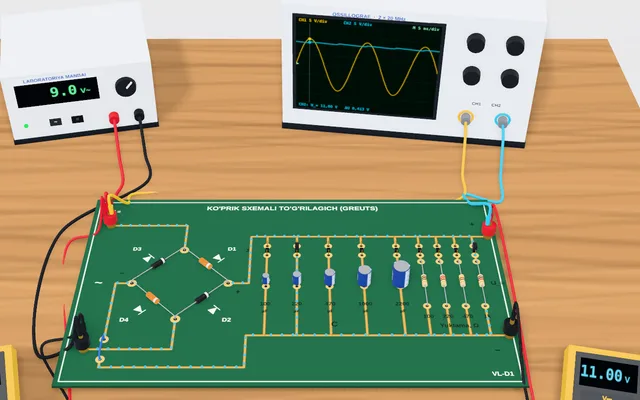 Try it in the labDiode3D lab on this site →Share on Telegram
Sources: NobelPrize.org — 2014