Home › Nobel Prize laureates › 2016–2026 › 2025
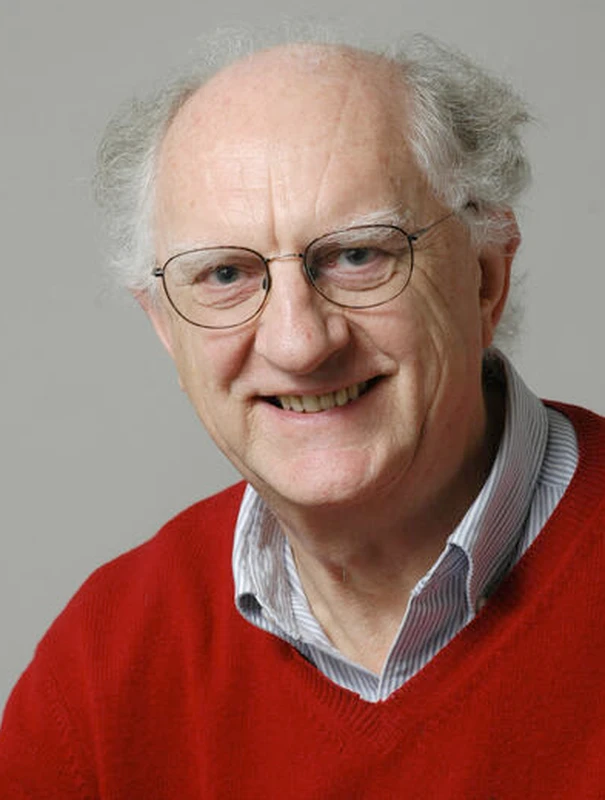
John Clarke
born 1942 · UK / USA
Prize motivation“for the discovery of macroscopic quantum mechanical tunnelling and energy quantisation in an electric circuit”
Shared the prize with: Michel H. Devoret, John M. Martinis
The discovery
In quantum mechanics a particle sometimes “leaks” through a barrier it cannot climb over, which is called quantum tunnelling. An electron in an atom can also only take certain energy values, which is energy quantisation. For a long time these effects were thought to belong only to the world of atoms and electrons.
In 1984–85 at the University of California, Berkeley, Clarke, Devoret and Martinis experimented with a superconducting circuit built around a Josephson junction: a very thin layer of insulator between two superconductors. Billions of electrons in it move together like one big particle.
Measuring the current, they saw the circuit escape from its zero-voltage state by quantum tunnelling. When they shone microwaves on it, they found it jumped only between separate energy levels, just like an atom. A chip you could hold in your hand behaved like an “artificial atom”.
Life
Born in 1942 in Cambridge, UK, he studied and earned his doctorate at the University of Cambridge. From 1969 he worked at the University of California, Berkeley, where he was a professor for many years.
Clarke is known for building and applying superconducting quantum interference devices (SQUIDs), instruments that sense magnetic fields billions of times weaker than the Earth's.
Where it is used today
The discovery underpins superconducting quantum computers: the qubits in quantum processors from Google, IBM and others are made from exactly such circuits.
SQUIDs are used in medicine to record the very weak magnetic fields of the brain and heart (magnetoencephalography), in geology and in ultra-precise measurements. Quantum sensors and quantum cryptography are developing on the same basis.
 Try it in the labQuantum interference3D lab on this site →Share on Telegram
Sources: NobelPrize.org — 2025