Home › Nobel Prize laureates › 2016–2026 › 2026
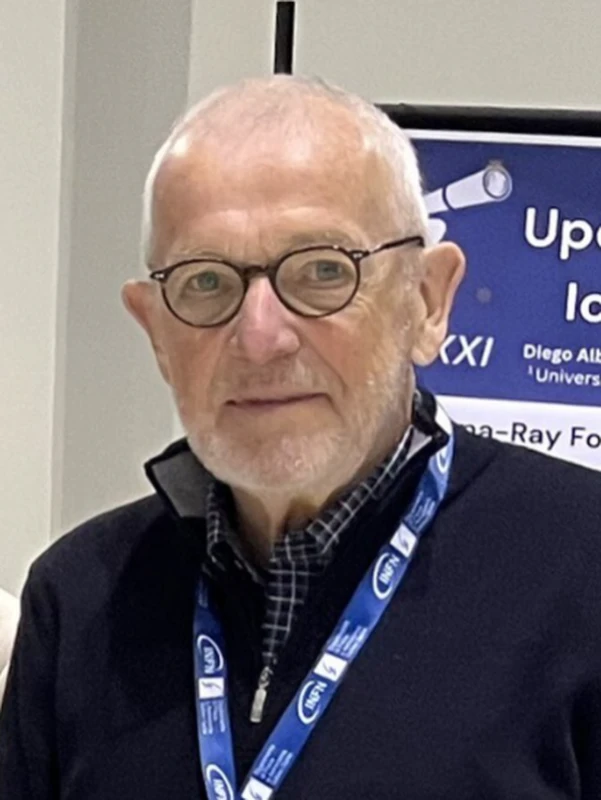
Francis Halzen
born 1944 · Belgium / USA
Prize motivation“for decisive contributions to the IceCube Neutrino Observatory and the discovery of high-energy neutrinos of astrophysical origin”
The discovery
A neutrino has no electric charge, is extremely light and hardly interacts with anything, which is why it is called a “ghost particle”: every second trillions of neutrinos from the Sun pass unnoticed through your body and the whole Earth. Wolfgang Pauli predicted it in 1930, but it was only detected in 1956.
Because neutrinos travel almost unhindered, they can carry news from the most distant and violent places in the Universe, such as black holes and exploding stars. But catching them is very hard and needs a huge volume of transparent material. Halzen proposed turning the Antarctic ice itself into a detector.
IceCube was completed in 2010. Hot water was used to drill 86 deep holes in the ice, and 5,160 light sensors were lowered into them at depths of 1,450–2,450 metres. Very rarely a neutrino collides with an atom in the ice and creates a fast charged particle. It gives off a faint bluish flash of Cherenkov light, from which the sensors work out the neutrino's direction and energy.
In 2013 IceCube detected the first high-energy neutrinos from beyond the Solar System and our Galaxy. In 2018 a single neutrino was traced to a blazar, an active galactic nucleus about 4 billion light-years away. Later, neutrinos were also found from the galaxy NGC 1068 and from the Milky Way itself.
Life
Born on 23 March 1944 in Tienen, Belgium. He studied physics at the University of Louvain, earning a master's degree in 1966 and a doctorate in 1969, and worked at CERN in Geneva from 1969 to 1971.
Since 1972 he has been a professor at the University of Wisconsin–Madison in the USA. He started as a theorist in particle physics and cosmic rays, took part in AMANDA, the first neutrino telescope in ice, in the 1990s, and has led IceCube as principal investigator since 2001.
Where it is used today
Neutrino astronomy has given us a new “eye” on the Universe. Light is blocked by clouds of dust and gas, but neutrinos pass straight through, so they reveal directly what happens around the most powerful particle accelerators in the cosmos, the supermassive black holes.
IceCube works together with telescopes and gravitational-wave detectors, so a single event can be studied through light, neutrinos and waves at once. This is called multi-messenger astronomy.
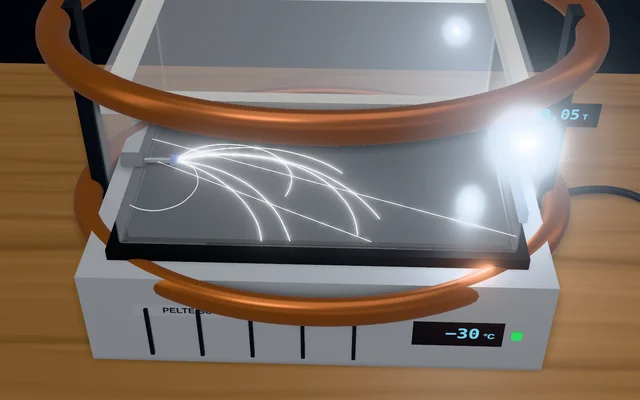 Try it in the labCloud chamber3D lab on this site →Share on Telegram
Sources: NobelPrize.org — 2026 · Physics World