GW190814: a mystery object that fits neither as neutron star nor black hole
The signal was recorded on 14 August 2019 and announced on 23 June 2020; the collision happened about 800 million years ago.
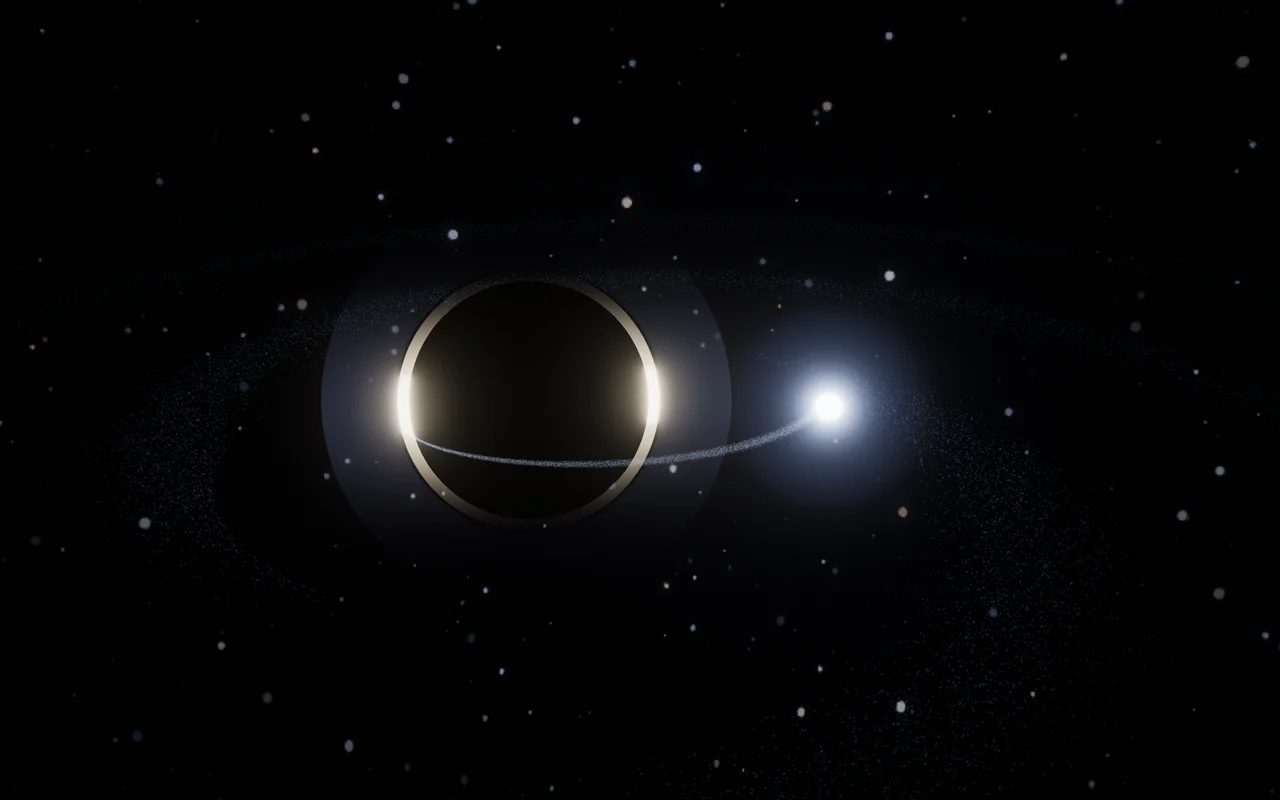
Image: Virtual Lab (3D illustration)
When a massive star dies, its core collapses into a neutron star or a black hole. The heaviest neutron stars weigh about 2.5 solar masses, and the lightest known black holes about 5. Almost nothing had been found in between, a range called the 'mass gap'.
The smaller object in GW190814 fell right into that gap. If it was a neutron star, it was the heaviest ever seen; if a black hole, the lightest. Either way, theories of how stars die need rethinking.
The pair was very unequal — the larger body was 9 times heavier. Such lopsided pairs give the signal distinctive 'overtones' that allowed the masses to be measured more precisely. The merger produced a black hole of about 25 solar masses.
Telescopes searched that patch of sky for light but found none. The event may have been too distant, the small object may have been a black hole, or the big black hole may have swallowed a neutron star whole without tearing it apart.
 Try it in the labLever3D lab on this site →Share on Telegram
Sources: LIGO Caltech · EGO / Virgo