GW190521: the birth of an intermediate-mass black hole is observed
The signal was recorded on 21 May 2019 and announced on 2 September 2020. It was the most massive and most distant gravitational-wave source yet.
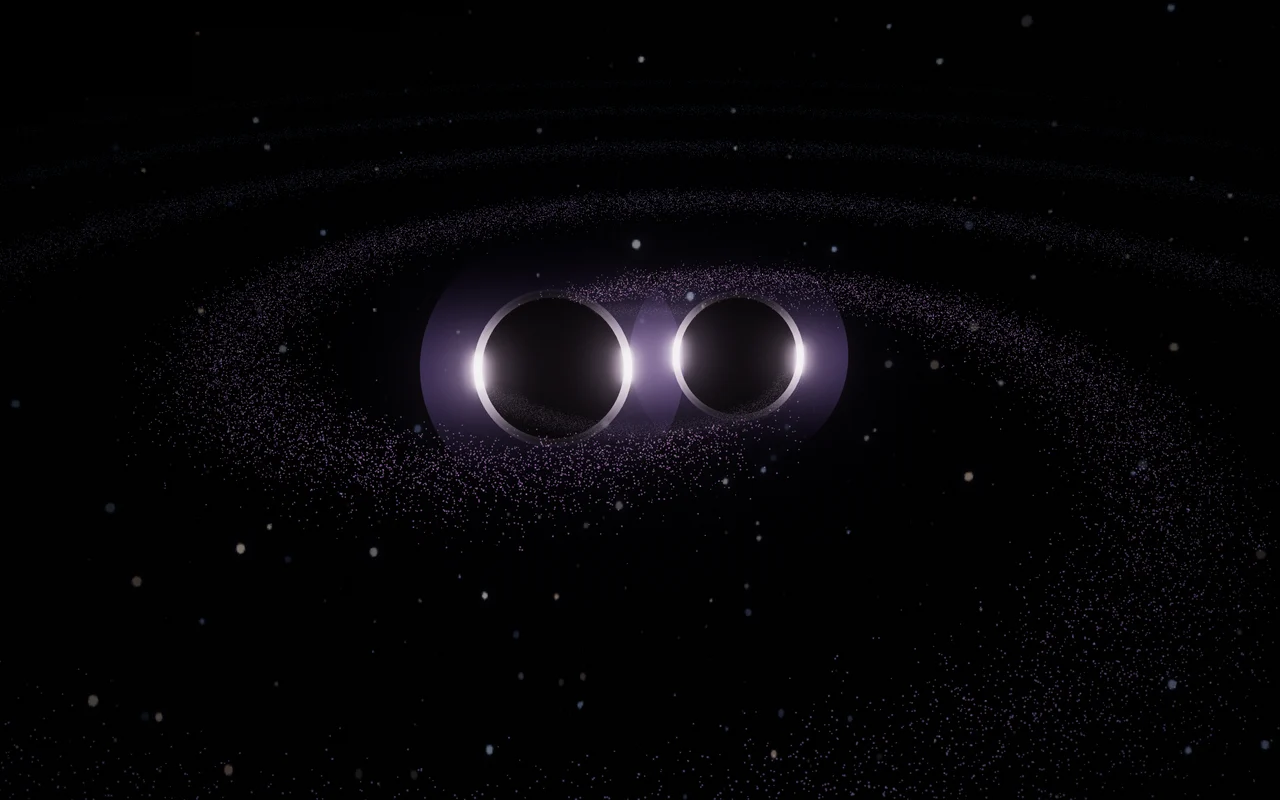
Image: Virtual Lab (3D illustration)
Two kinds of black hole were known: 'small' ones left by stars, tens of solar masses, and 'giants' of millions to billions of solar masses in galaxy centres. Intermediate-mass black holes had long eluded detection.
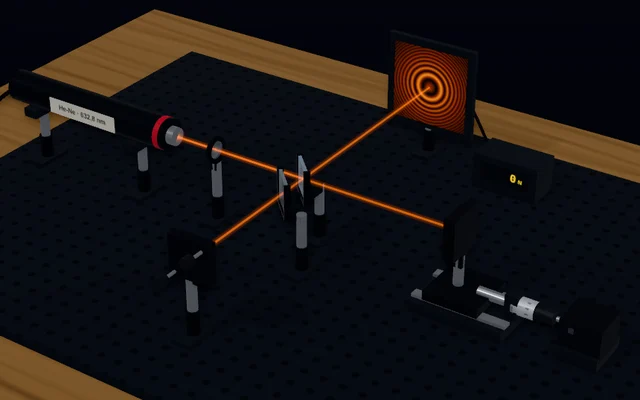
Each LIGO detector has two perpendicular 4-km arms. Laser light runs along the arms and is recombined; a passing gravitational wave changes the arm lengths by less than the width of a proton, which shows up in the pattern formed when the beams combine.
The GW190521 signal lasted only 0.1 seconds — just four wiggles. The merger turned 8 solar masses of matter into gravitational-wave energy. The signal set out about 7 billion years ago, when the universe was half its present age.
Surprisingly, the 85-solar-mass black hole should not exist at all: theory says very massive stars are blown apart by 'pair instability' and leave no black holes of 65–120 solar masses. It may itself have formed from an earlier merger of two black holes.
 Try it in the labMichelson interferometer3D lab on this site →Share on Telegram
Sources: LIGO Caltech · Penn State