A giant planet found surviving around a dead star
The discovery was published on 16 September 2020 in Nature. The system lies 80 light years away in the constellation Draco.
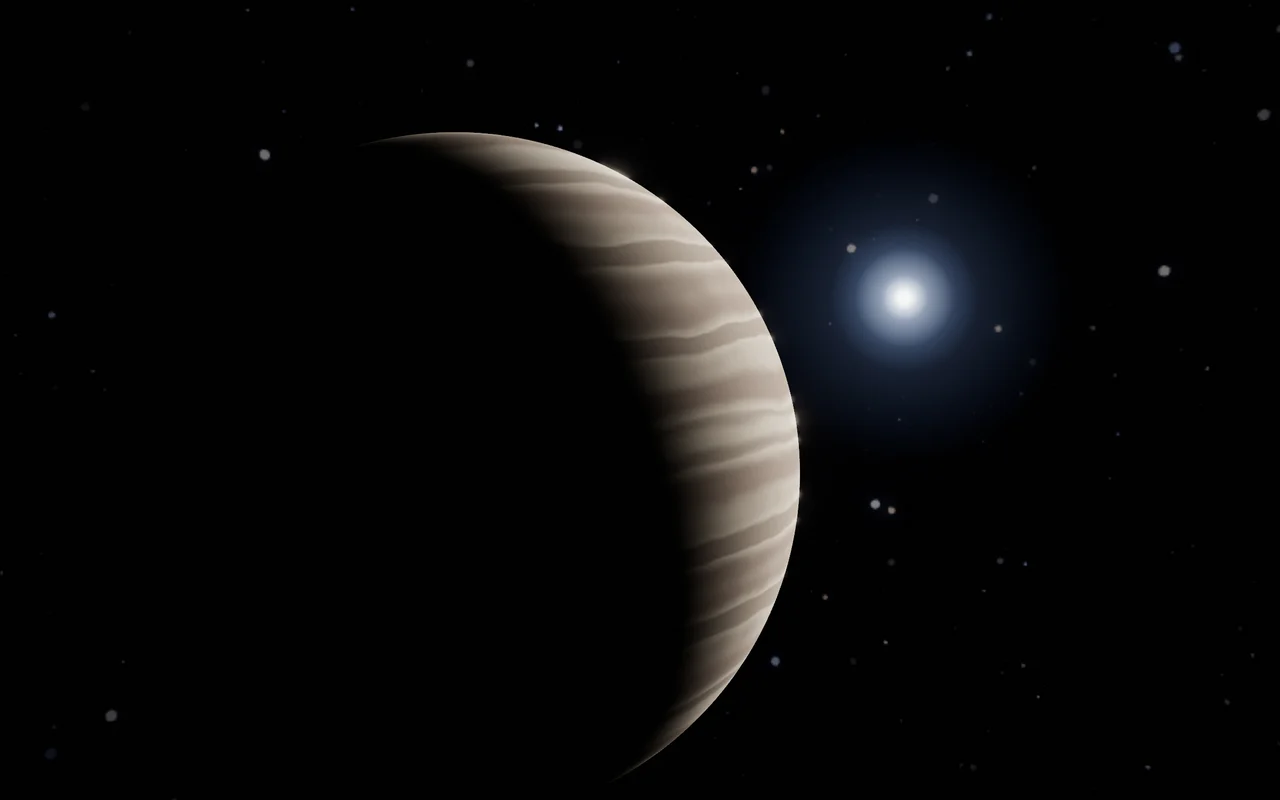
Image: Virtual Lab (3D illustration)
When a Sun-like star runs out of fuel, it swells into a red giant hundreds of times larger, swallowing nearby planets, then sheds its outer layers to become an ultra-dense, Earth-sized white dwarf. Our Sun will do the same in about 5 billion years.
The white dwarf WD 1856+534 is about 18,000 km across and may be up to 10 billion years old. TESS saw its light dip sharply every 34 hours as a huge body passed in front; the Spitzer infrared telescope confirmed it was a cool planet, not a star.
The planet is about 20 times closer to its star than Mercury is to the Sun, moving so fast that the star's gravity keeps it on a circular path. But at that distance it could not have survived the star's red-giant phase.
So it must have formed at least 50 times farther out and later been nudged by other planets or nearby stars onto an elongated orbit that brought it close. Such systems suggest that even dead stars might host habitable planets.
 Try it in the labCentripetal force3D lab on this site →Share on Telegram
Sources: NASA Exoplanets · UC Riverside