Jiuzhang: a light-based quantum computer outpaces supercomputers
The results were published on 3 December 2020 in Science; the work was led by Pan Jianwei and Lu Chaoyang of the University of Science and Technology of China.
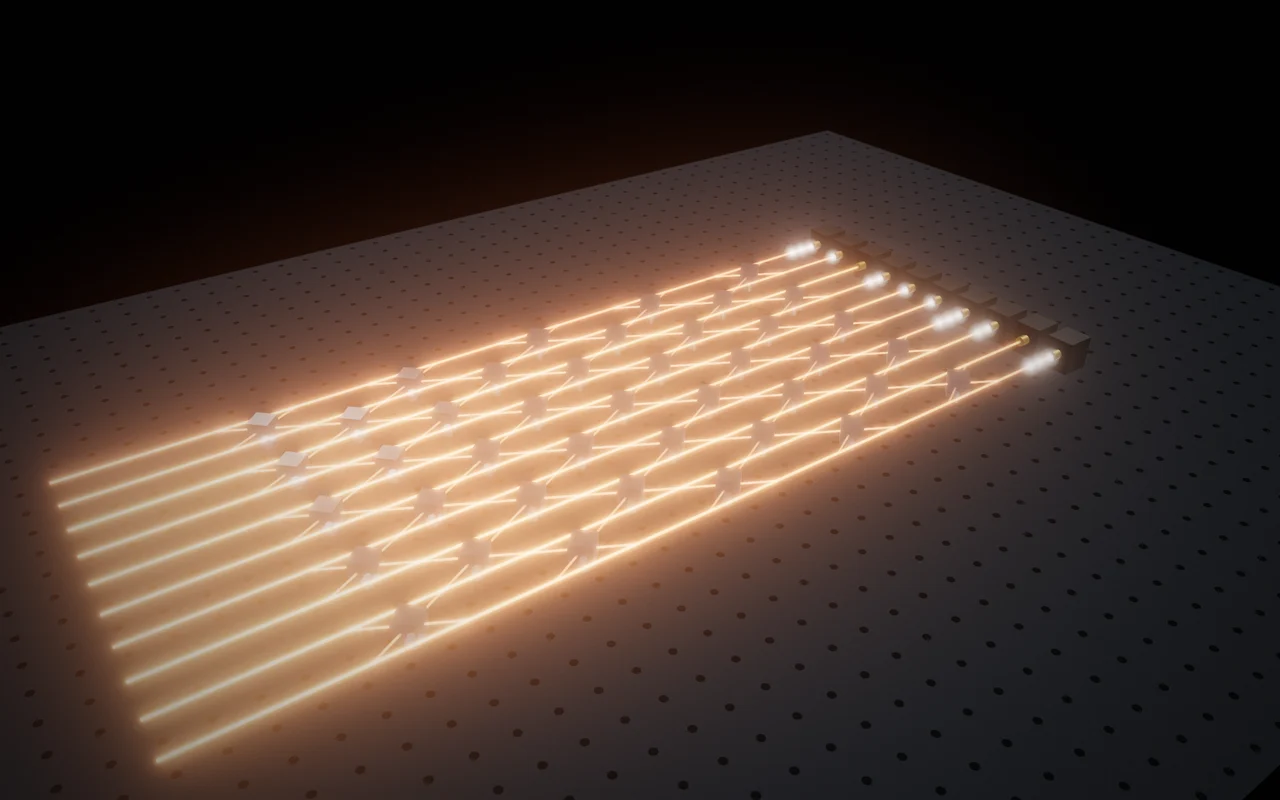
Image: Virtual Lab (3D illustration)
The computer is named after an ancient Chinese mathematics text, 'The Nine Chapters on the Mathematical Art' (Jiuzhang Suanshu). Google's 2019 Sycamore processor used supercooled qubits; Jiuzhang works quite differently, by manipulating particles of light.
The device is a network of hundreds of mirrors, prisms and half-silvered plates on an optical table. Photons are sent in; at each element a photon splits into two paths, the paths rejoin, and the photons interfere according to quantum rules. At the end, the number of photons reaching each of 100 outputs is counted.
Up to 76 photons were detected in a single run. Repeating the run many times builds up a distribution of photons across the outputs. Calculating that distribution on an ordinary computer gets dramatically harder as the photon count grows, while Jiuzhang simply 'performs' it, as nature does.
The task has no practical use yet, and Jiuzhang is not a universal, programmable computer. But it independently confirmed that quantum devices can genuinely outpace ordinary computers on certain problems.
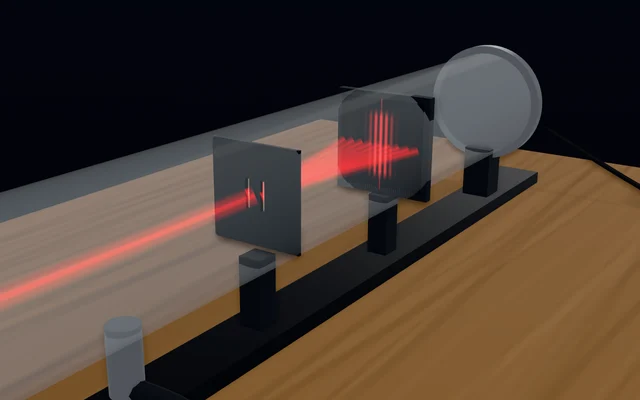 Try it in the labQuantum interference3D lab on this site →Share on Telegram
Sources: Science News · Chinese Academy of Sciences