The fine-structure constant is measured more precisely than ever
The results were published on 2 December 2020 in Nature by Saïda Guellati-Khélifa's group at the Kastler Brossel Laboratory.
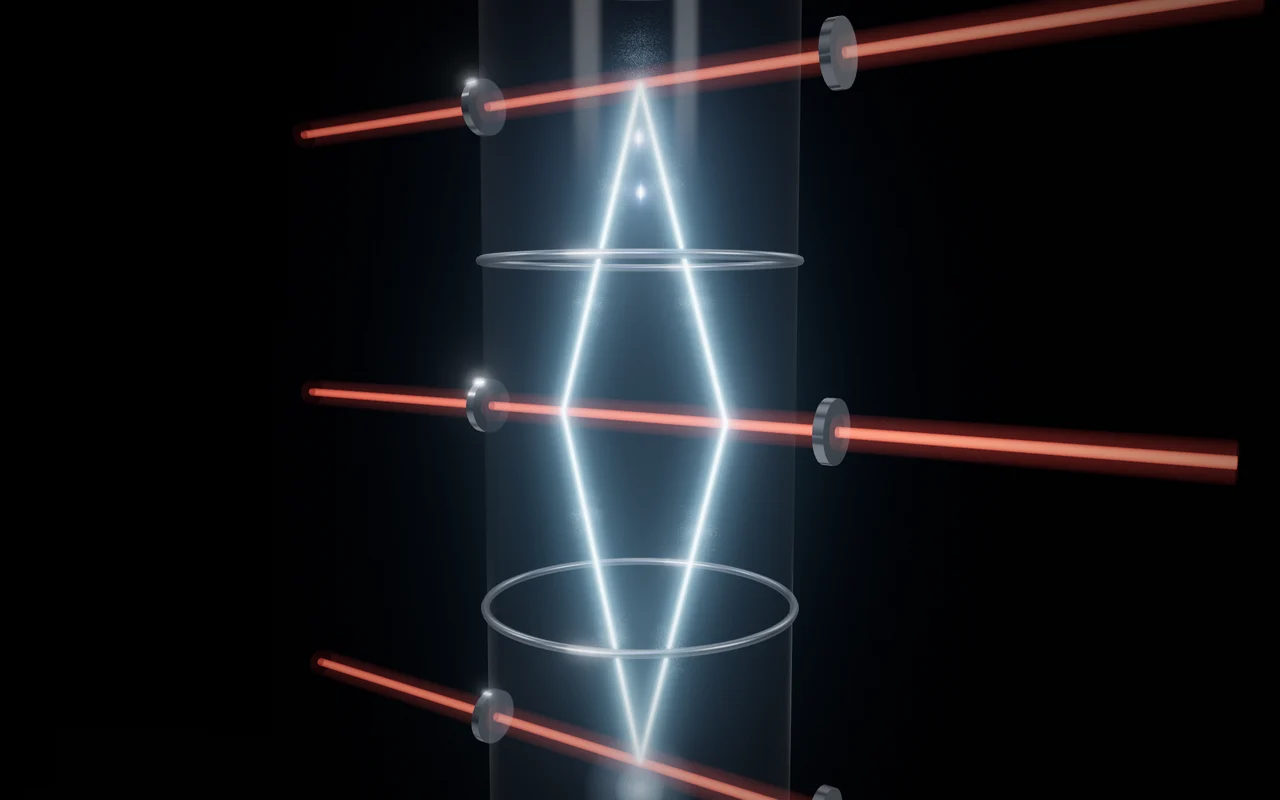
Image: Virtual Lab (3D illustration)
The fine-structure constant is a pure number without units, about 1/137. It measures how strongly charged particles interact with light, and governs the size of atoms, chemical bonds and the colours of materials. Richard Feynman called it a 'magic number'.
In the experiment, rubidium atoms were cooled almost to absolute zero. When an atom absorbs a photon it recoils, like a boat when someone in it catches a ball. The recoil speed depends on the atom's mass, from which the fine-structure constant can be calculated.
The recoil is tiny — a few millimetres per second — so it is measured with an atom interferometer: laser pulses split each atom's wave in two, send the halves along different paths and recombine them. The resulting pattern reveals the atom's speed with great precision.
The new value confirmed the theoretical prediction for the electron's magnetic properties to better than one part in a billion. But it differs noticeably from the value measured at Berkeley in 2018, and explaining that gap became a new puzzle.
 Try it in the labMach–Zehnder interferometer3D lab on this site →Share on Telegram
Sources: CNRS · Quanta Magazine