Muon g-2: the muon wobbles in a magnetic field differently than theory predicted
The result was announced on 7 April 2021 and published in Physical Review Letters.
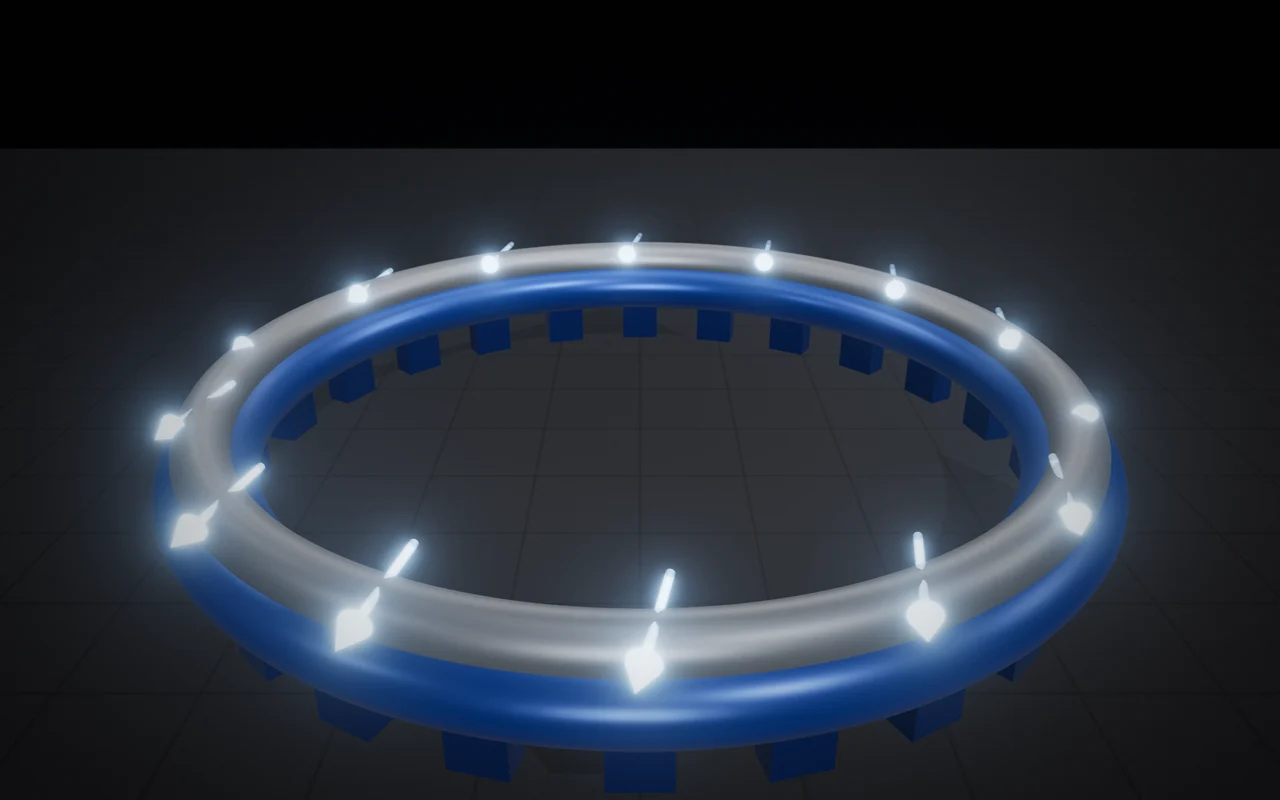
Image: Virtual Lab (3D illustration)
The muon is the electron's heavy cousin — 200 times heavier, living just 2.2 microseconds. It behaves like a tiny magnet, and in a magnetic field its magnetic axis turns like a spinning top's — it precesses. The rate is set by the number g, which simple theory says should be exactly 2.
But in the quantum world empty space isn't empty: virtual particles constantly pop in and out, nudging the muon and making g slightly larger than 2 — hence the name 'g minus 2'. Any unknown particles would add to this difference too.
The experiment uses a superconducting magnetic ring 15 metres across, moved in 2013 from Brookhaven to Fermilab — more than 5,000 kilometres by barge and truck. Muons circle the ring, and electrons from their decay reveal how far they have precessed.
The first result confirmed Brookhaven's; together they differed from the then theoretical prediction by 4.2 standard deviations. Later, however, theorists recalculated the strong-force contribution on supercomputers, bringing the prediction closer to experiment, and with the experiment's final 2025 result the discrepancy has all but vanished.
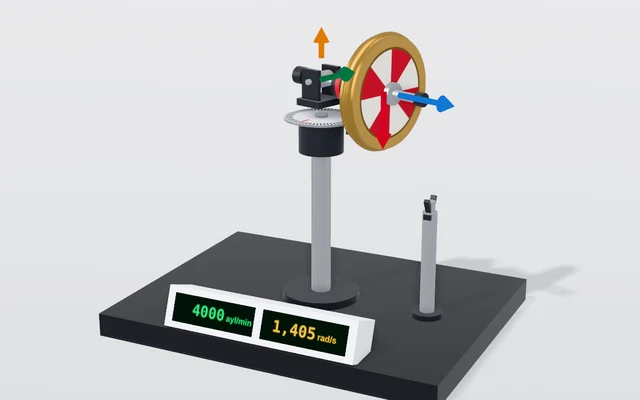 Try it in the labGyroscope3D lab on this site →Share on Telegram
Sources: Fermilab / Illinois · Wikipedia