A white dwarf the size of the Moon but heavier than the Sun
The result was published in Nature on 30 June 2021, in work led by Ilaria Caiazzo.
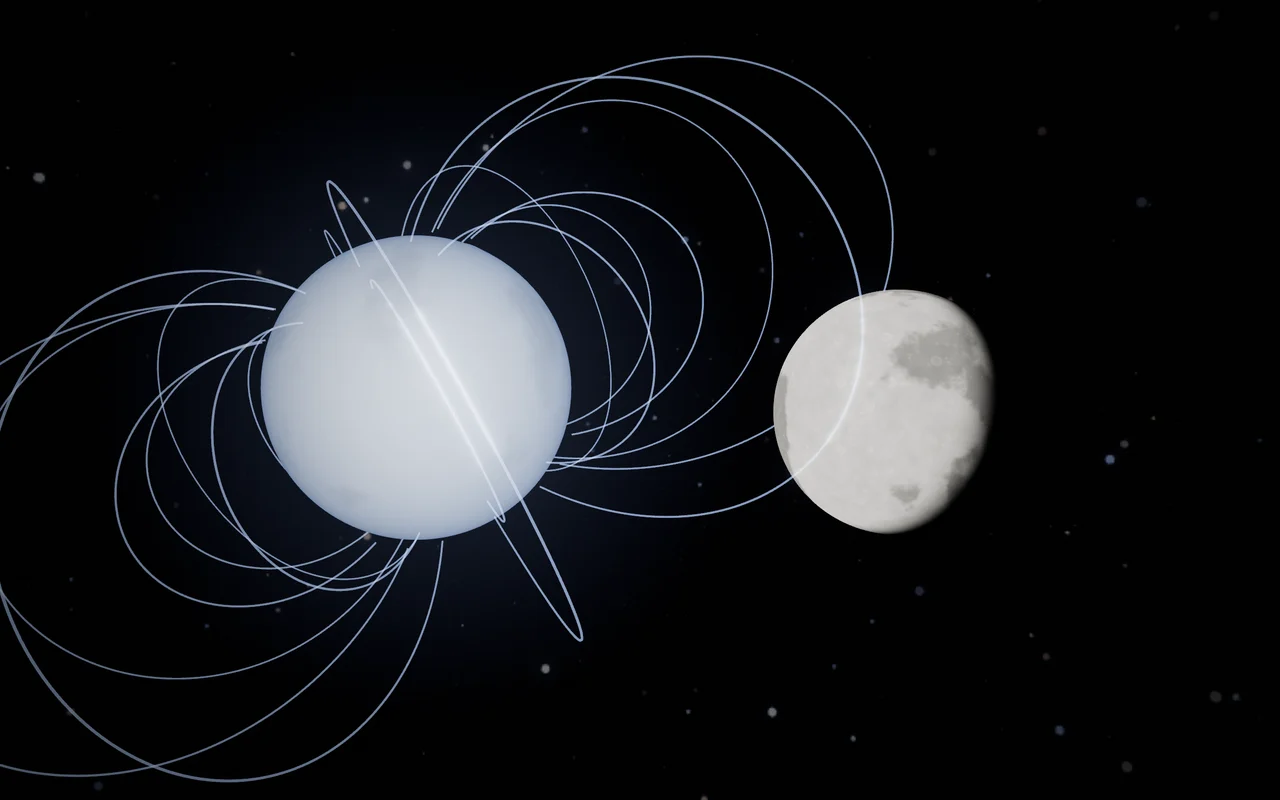
Image: Virtual Lab (3D illustration)
A white dwarf is the dense core left when a Sun-like star runs out of fuel, held up against collapse by the pressure of electrons. Strangely, the heavier a white dwarf, the smaller it is; above about 1.4 solar masses — the Chandrasekhar limit — that pressure is no longer enough.
ZTF J1901+1458 was spotted by the Zwicky Transient Facility at Palomar Observatory in California, 130 light years away, and then studied with the Keck telescopes in Hawaii and others.
It spins once every 7 minutes — very fast for a white dwarf — and its magnetic field is a billion times stronger than the Sun's. Scientists think these traits come from the merger of two lighter white dwarfs.
'We have found a star packing a mass greater than that of our Sun into a body about the size of our Moon,' says Caiazzo. Being so close to the limit, it may one day have its electrons absorbed by nuclei and collapse into a neutron star.
 Try it in the labGas laws3D lab on this site →Share on Telegram
Sources: ScienceDaily (Keck) · Nature (DOI)