A moon-forming disc around an exoplanet seen clearly for the first time
The result was published in The Astrophysical Journal Letters on 22 July 2021, in work led by Myriam Benisty.
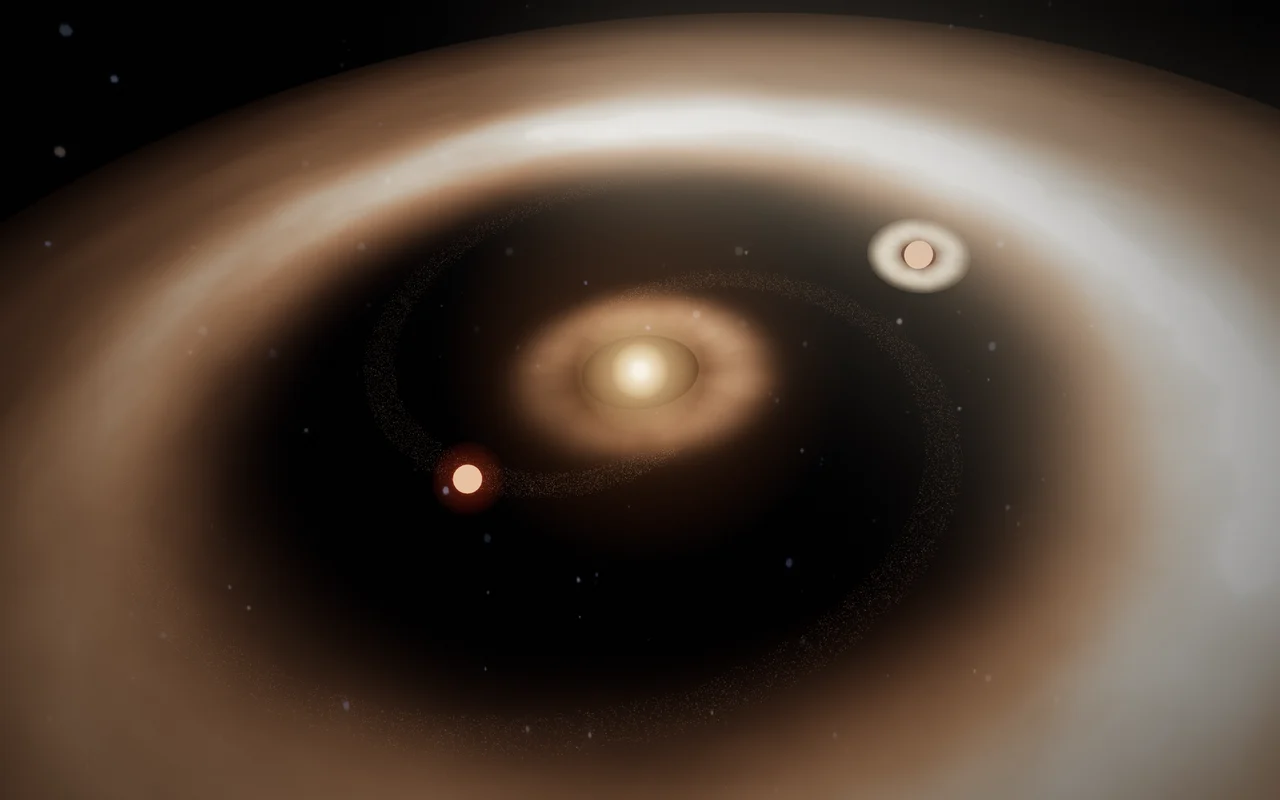
Image: Virtual Lab (3D illustration)
PDS 70 is a very young star about 400 light years away, still surrounded by a disc of gas and dust in which planets form. Two young Jupiter-like planets, PDS 70b and PDS 70c, orbit in its inner part, having cleared a large gap as they swallow material.
Planets form in discs around stars, and moons are thought to form in smaller discs around planets — perhaps how Jupiter's four big moons were born. But such a disc around another star is very hard to see, being small and embedded in the larger disc.
ALMA's sharp vision let the team separate a bright spot around PDS 70c from the big disc, proving it belongs to the planet. The disc is about one astronomical unit across — 500 times larger than Saturn's rings.
No such disc was found around the neighbouring PDS 70b; perhaps the outer PDS 70c captures the incoming material and starves b. 'Our work presents a clear detection of a disc in which satellites could be forming,' says Benisty.
 Try it in the labNewton's cradle3D lab on this site →Share on Telegram
Sources: ESO · ScienceDaily (CfA)