Light from behind a black hole seen for the first time
The result was published in Nature on 28 July 2021, in work led by Dan Wilkins of Stanford University.
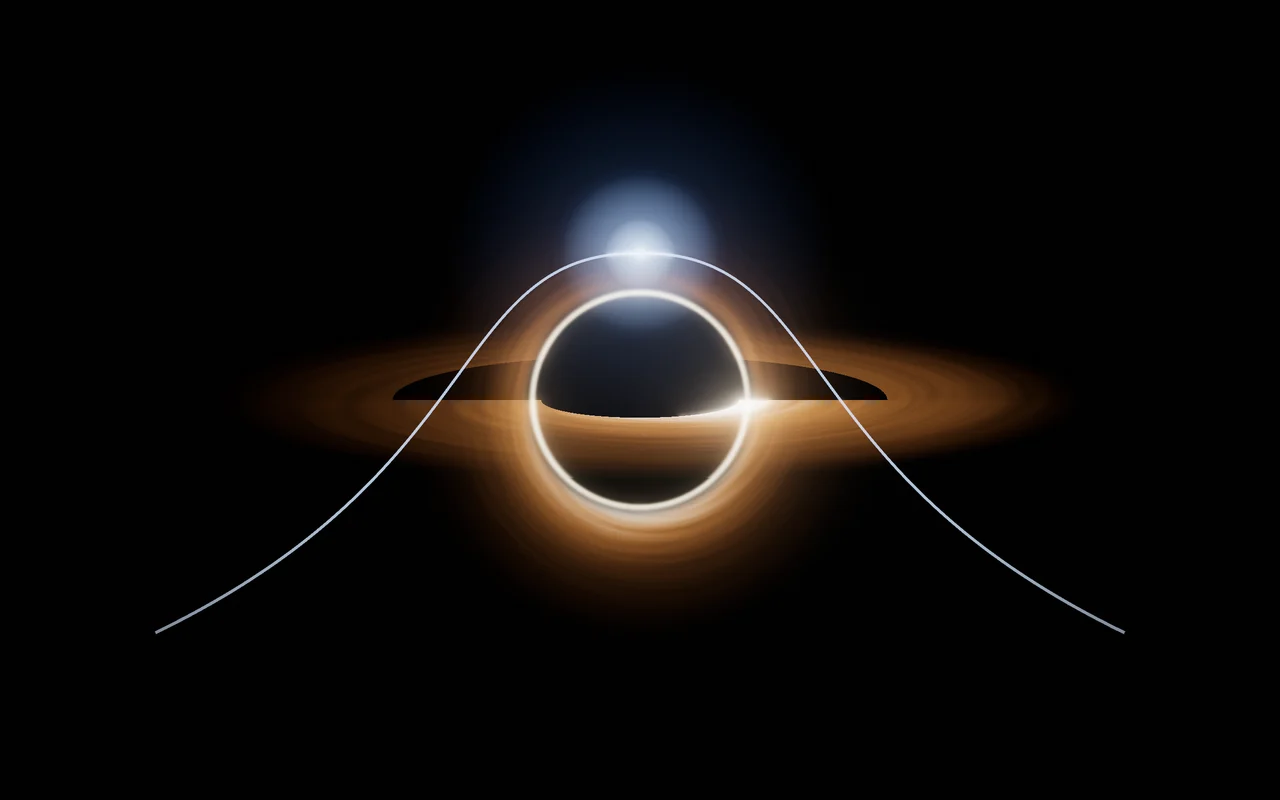
Image: Virtual Lab (3D illustration)
The black hole sits at the centre of the galaxy I Zwicky 1, 800 million light years away, and is 10 million times the Sun's mass. Gas swirls around it in a hot disc, and above the disc a 'corona' of extremely hot gas emits powerful X-ray flares from time to time.
Part of each flare's light comes straight to us; part hits the disc and reflects, arriving slightly later — like an echo in the mountains. The delay and the energy of the reflected light reveal which part of the disc it bounced off.
In data from Europe's XMM-Newton and NASA's NuSTAR, the team found short extra flashes after the main echoes, with unexpected delays and colours. Calculations showed this light had reflected from the part of the disc behind the black hole, bent around it by intense gravity and sent our way.
'Any light that goes into that black hole doesn't come out, so we shouldn't be able to see anything that's behind the black hole,' says Wilkins. 'The reason we can see that is because that black hole is warping space, bending light and twisting magnetic fields around itself.'
 Try it in the labLenses and mirrors3D lab on this site →Share on Telegram
Sources: Nature (DOI) · Space.com