First possible planet in another galaxy: an X-ray 'eclipse' in M51
The result was published in Nature Astronomy on 25 October 2021, in work led by Rosanne Di Stefano.
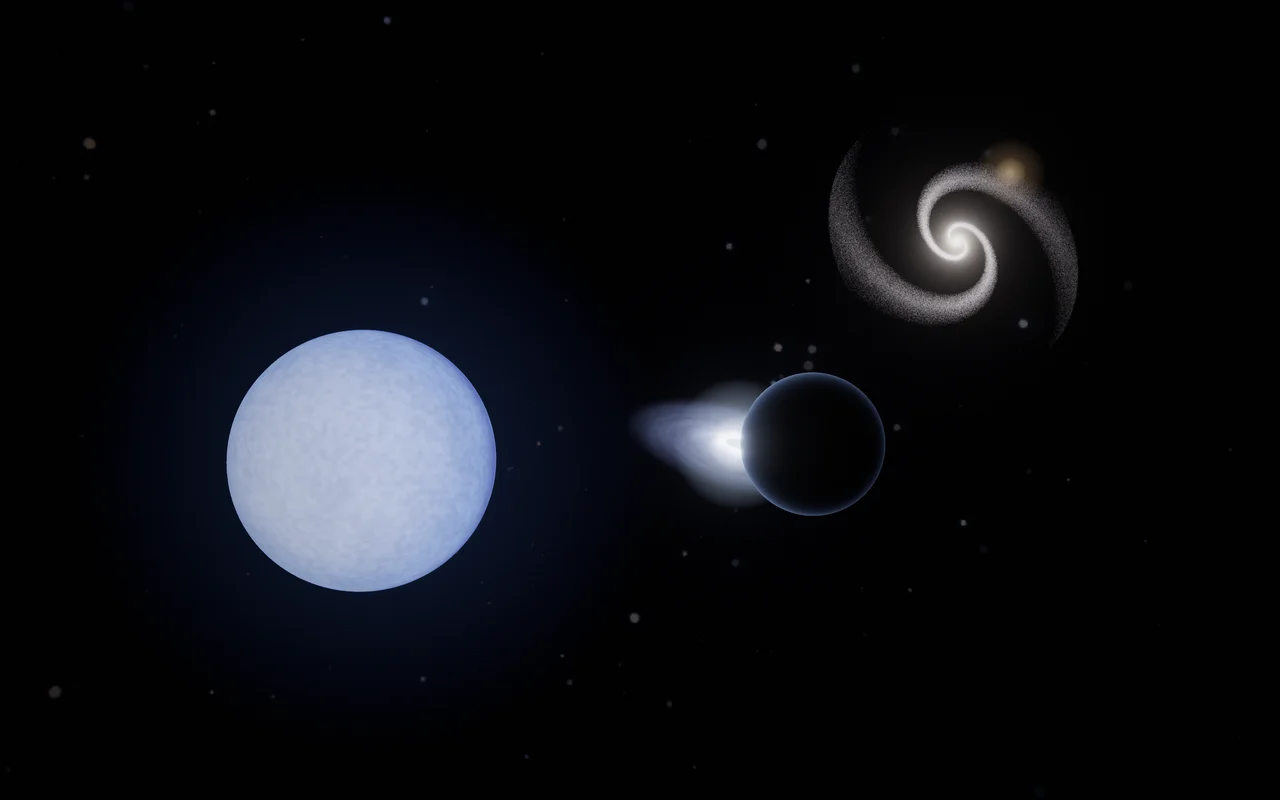
Image: Virtual Lab (3D illustration)
Almost all of the 5,000-plus known exoplanets lie within a few thousand light years of us. Stars in other galaxies are too faint and crowded for the usual methods to find their planets.
Di Stefano's team took a different approach, watching X-rays rather than visible light. M51-ULS-1 is a pair made of a neutron star or black hole and a large star; gas pulled from the star heats up and emits X-rays from a very small region, so a passing planet can block it completely.
In a 2012 observation, the source's brightness fell smoothly to zero over about three hours and then recovered — a shape that closely matches a planetary transit. Calculations suggest a planet roughly the size of Saturn, orbiting about twice as far from the pair as Saturn is from the Sun.
Unfortunately, on such a wide orbit the next transit is about 70 years away, so the result can't be checked quickly and remains a 'candidate'. But the technique opens a new way to search for planets in other galaxies.
 Try it in the labX-rays3D lab on this site →Share on Telegram
Sources: Chandra / CfA · Wikipedia