Time measured running differently across a single millimetre of height
The result was published in Nature on 16 February 2022 and made the cover; the work was done by Tobias Bothwell and Jun Ye at JILA.
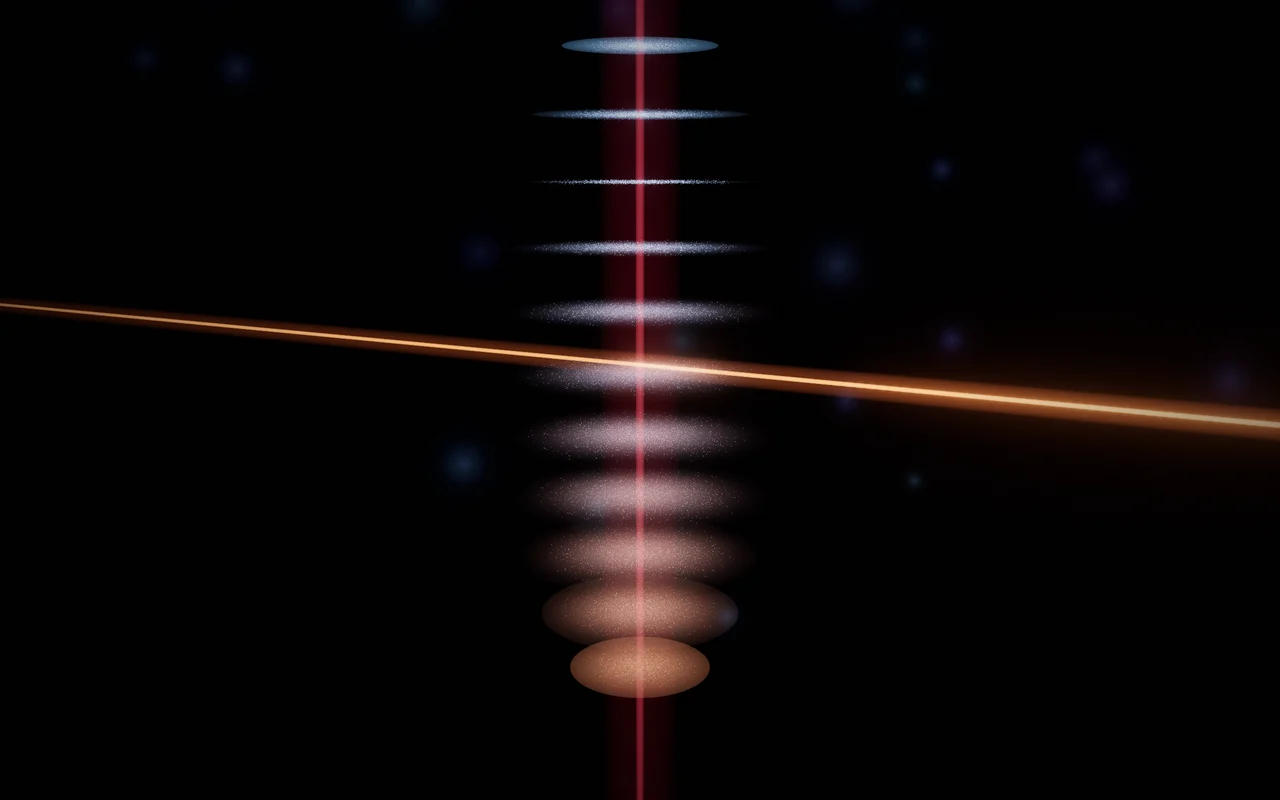
Image: Virtual Lab (3D illustration)
Einstein's general relativity says time runs slower where gravity is stronger, so a clock closer to Earth ticks slightly slower than one higher up. GPS satellites must account for this, or they would drift by kilometres a day.
Atomic clocks use the frequency of light emitted when an electron jumps between two energy levels. That frequency is extraordinarily stable, making it the most precise 'pendulum'; the best atomic clocks would lose less than a second over the age of the universe.
The JILA team cooled about 100,000 strontium atoms to within a whisker of absolute zero and placed them on 'shelves' made of laser light, each layer acting as a separate clock. The cloud was about a millimetre tall.
Ninety hours of measurements revealed a smooth frequency change across the cloud of only about one part in 10¹⁹ — exactly as Einstein predicted — with precision 50 times better than any previous clock comparison.
 Try it in the labMechanical clock3D lab on this site →Share on Telegram
Sources: NIST · Nature (DOI)