Webb makes the first clear detection of carbon dioxide on a planet beyond the solar system
Announced on 25 August 2022 and later published in Nature, the work involved Webb's early-release science team of more than 300 researchers.
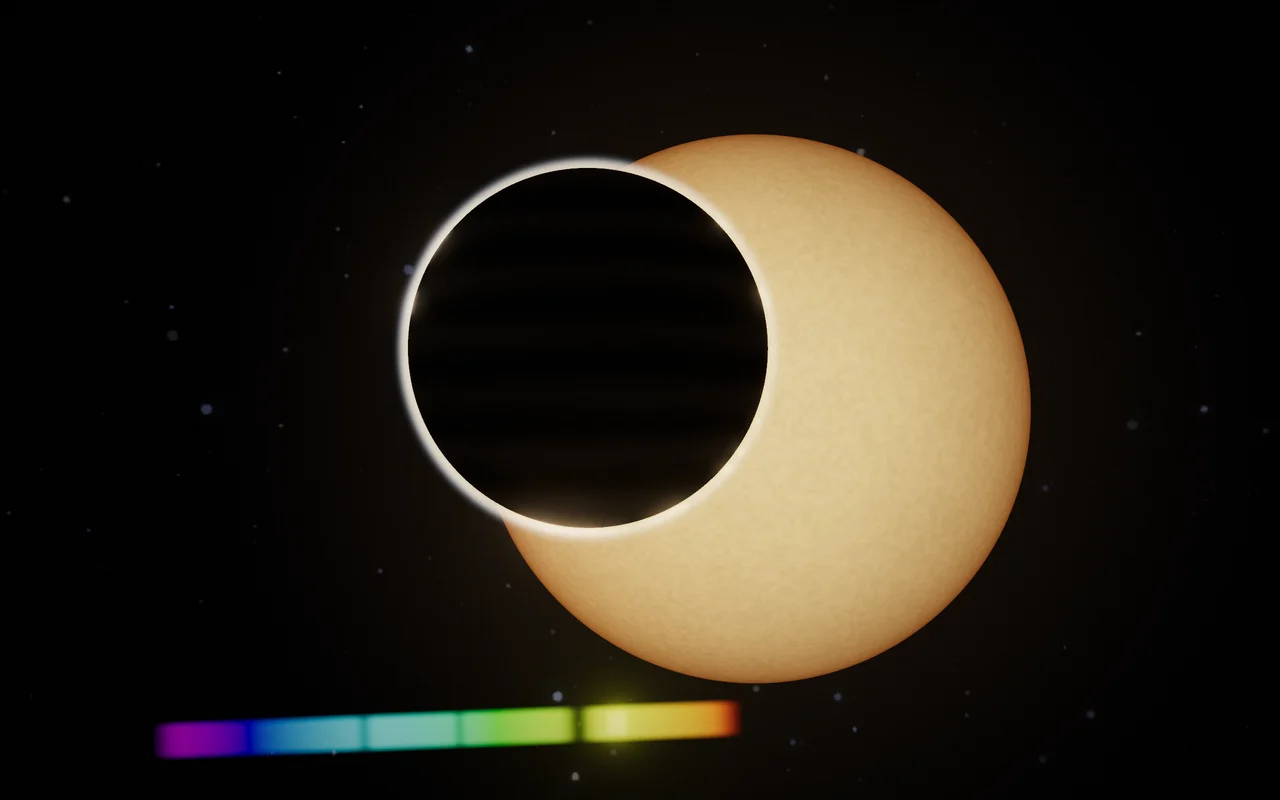
Image: Virtual Lab (3D illustration)
WASP-39 b is a 'hot Saturn' 700 light years away in the constellation Virgo. Its mass is similar to Saturn's but it is larger than Jupiter. It orbits so close to its star that a year lasts just 4 days, and its temperature reaches about 900 °C.
Each orbit, the planet passes in front of its star and some starlight filters through its atmosphere. Every substance absorbs its own wavelengths. Webb's NIRSpec spectrograph split the light into colours and showed which were missing: a clear 'bump' between 4.1 and 4.6 micrometres, the signature of carbon dioxide.
Spitzer and Hubble had hinted at such signals but could not show them clearly. 'As soon as the data appeared on my screen, the whopping carbon dioxide feature grabbed me,' said researcher Zafar Rustamkulov.
The amount of carbon dioxide reveals how the planet formed — how much solid material versus gas it gathered. Later analyses found sulphur dioxide, produced by starlight: the first photochemistry seen on another planet. Such techniques will one day help search Earth-like planets for signs of life.
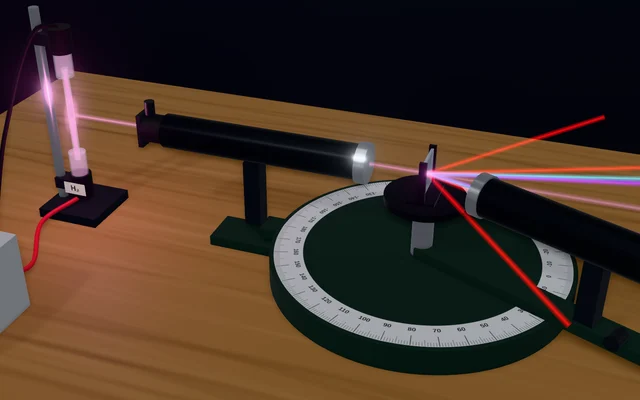 Try it in the labAtomic spectra3D lab on this site →Share on Telegram
Sources: NASA Webb · Nature (DOI)