Evidence that protons contain charm quarks heavier than the proton itself
Published in Nature on 17 August 2022, the work by physicists in Milan, Amsterdam and Edinburgh was led by Juan Rojo.
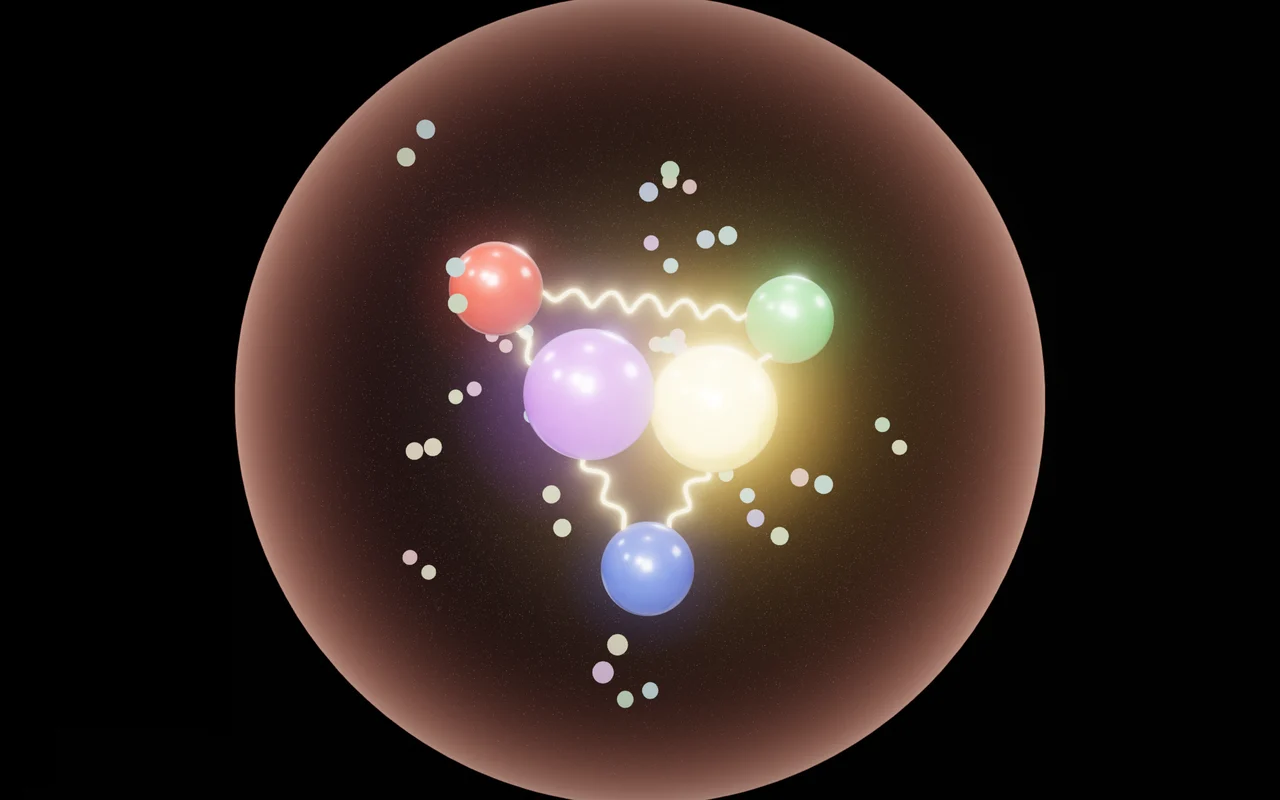
Image: Virtual Lab (3D illustration)
Textbooks say a proton is two up quarks and one down quark. In reality it is far more complex, filled with gluons that bind the quarks and quark–antiquark pairs constantly popping in and out of existence — a 'quantum foam'. Almost all of the proton's mass comes from the energy of this strong interaction.
A charm quark has a mass of about 1.3 GeV; a proton, 0.94 GeV. In 1980 Stanley Brodsky and colleagues proposed that charm quarks might be a permanent part of the proton, but for more than 40 years the idea could be neither proven nor ruled out.
Protons are studied by smashing other particles into them at high energy — much as Rutherford probed the atom with alpha particles. The NNPDF team used a neural network to combine thousands of measurements from many accelerators, working out what share of the proton's momentum each type of quark carries.
Charm quarks turned out to carry about half a percent of the proton's momentum, at a significance of 3 standard deviations — 'evidence' in physicists' terms, not yet a 'discovery'. 'It sounds crazy that the proton contains quarks heavier than itself,' says Rojo. But in the quantum world, energy and mass can turn into each other.
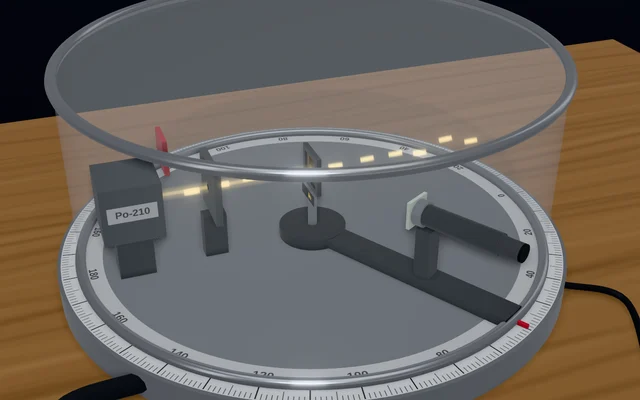 Try it in the labRutherford scattering3D lab on this site →Share on Telegram
Sources: Nature (DOI) · Nikhef