Matter–antimatter difference seen in baryons for the first time
On 24 March the LHCb collaboration presented the result at the Rencontres de Moriond conference.
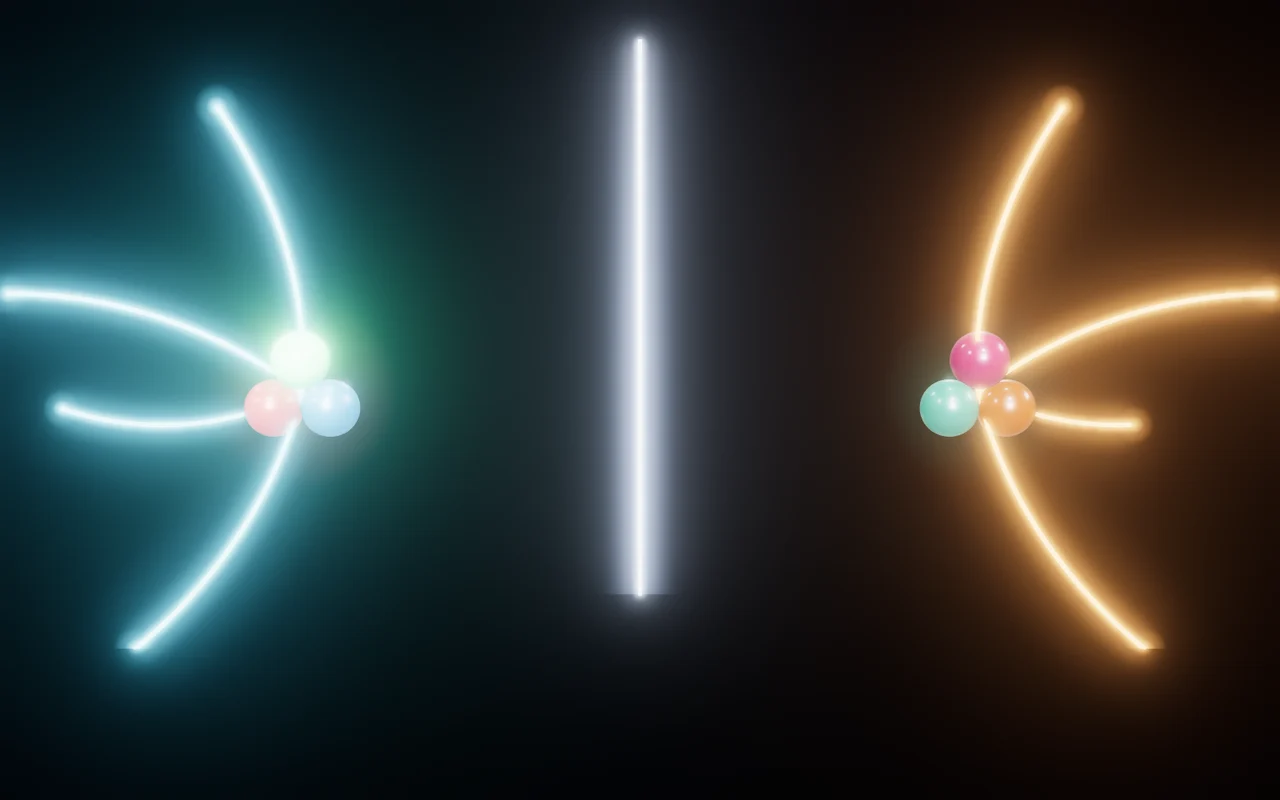
Image: Virtual Lab (3D illustration)
The Big Bang should have produced equal amounts of matter and antimatter. Had they behaved exactly alike, they would have annihilated each other completely and left an empty Universe. We exist, so the laws of nature must treat matter and antimatter slightly differently. This difference is called CP violation.
CP violation was discovered in kaons in 1964 and later seen in other mesons, particles made of a quark and an antiquark. But it had never been reliably observed in baryons, the three-quark particles that make up most of the visible matter in the Universe.
LHCb compared decays of the beauty-lambda baryon (made of u, d and b quarks) and its antiparticle in data from 2011 to 2018, analysing about 80,000 decays. The number of decays by the same route differed between particle and antiparticle by 2.45%, with an uncertainty of 0.47%. The significance is 5.2 sigma, enough for a formal discovery.
The paper was published in Nature in July 2025. Even so, the CP violation predicted by the Standard Model is far too small to explain why matter dominates the Universe, so physicists keep searching for new sources of it.
 Try it in the labElectric field3D lab on this site →Share on Telegram
Sources: CERN · Live Science