An alchemist's dream: CERN turns lead into gold
The ALICE collaboration published the result in Physical Review C in May 2025.
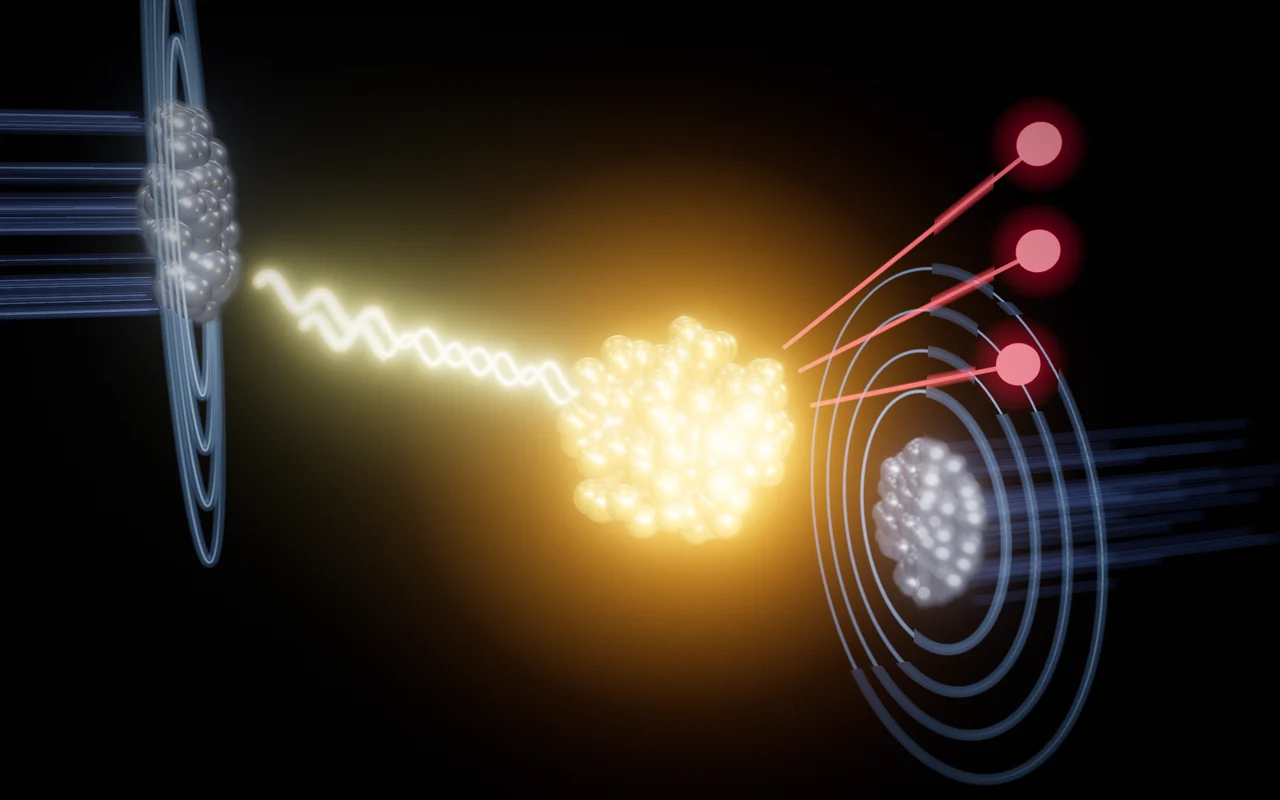
Image: Virtual Lab (3D illustration)
Medieval alchemists dreamed of turning cheap lead into precious gold, perhaps because the two metals have almost the same density. Later it became clear that they are different chemical elements, and no chemical method can turn one into the other.
An element is defined by the number of protons in its nucleus: lead has 82, gold 79. So three protons must be knocked out of a lead nucleus — something only nuclear physics can do.
In the collider, lead nuclei travel at nearly the speed of light. When two pass very close without colliding, they generate an enormous electromagnetic field that acts like a burst of powerful photons, knocking protons and neutrons out of a nucleus. Lose three protons, and lead becomes gold.
Special calorimeters in the ALICE detector counted the ejected protons and neutrons to measure how much gold formed. At peak, up to 89,000 gold nuclei were created per second — but within an instant they hit the collider walls and break apart. Nobody will get rich this way.
 Try it in the labRutherford scattering3D lab on this site →Share on Telegram
Sources: ALICE / CERN · Scientific American