Home › Nobel Prize laureates › 2006–2015 › 2006
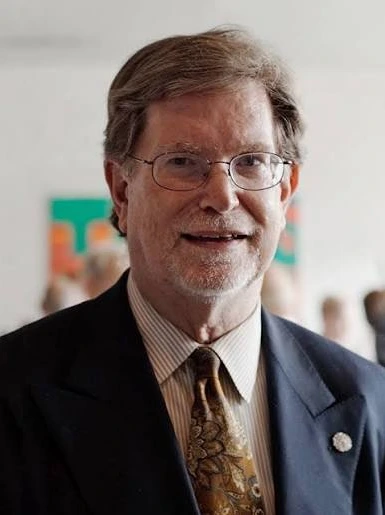
George F. Smoot
1945–2025 · USA
Prize motivation“for their discovery of the blackbody form and anisotropy of the cosmic microwave background radiation”
Shared the prize with: John C. Mather
The discovery
About 380,000 years after the Big Bang the universe cooled enough to become transparent. The light released then still reaches us, but the expansion of the universe has stretched it into microwaves. This is the cosmic microwave background, discovered by chance in 1965.
On 18 November 1989 NASA launched the COBE satellite, a project involving more than a thousand people. John Mather was its senior scientist and led FIRAS, the instrument that measured the radiation's spectrum. It matched a perfect blackbody curve at about 2.7 K, strong evidence for the Big Bang.
George Smoot led DMR, which compared the temperature in different directions across the sky, and in 1992 found tiny differences of about one part in a hundred thousand. These ripples were the seeds from which galaxies and stars later grew.
COBE turned cosmology from a science of guesswork into one of precise measurement, and the WMAP and Planck satellites later drew the map in even finer detail.
Life
Born on 20 February 1945 in Yukon, Florida, USA, he studied mathematics and physics at MIT, where he earned his doctorate in 1970.
He worked at Lawrence Berkeley National Laboratory from 1974 and was a professor at the University of California from 1994. In 2007 he used part of his prize money to found the Berkeley Center for Cosmological Physics. He died in Paris on 18 September 2025.
Where it is used today
Measurements of the background radiation pinned down the universe's age, about 13.8 billion years, and its make-up: about 5% ordinary matter, about 27% dark matter and the rest dark energy.
Mather later became senior project scientist of the James Webb Space Telescope, launched in 2021, which is observing the universe's first galaxies.
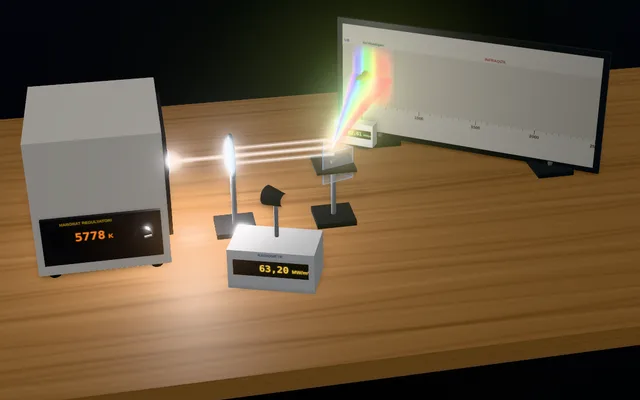 Try it in the labThermal radiation3D lab on this site →Share on Telegram
Sources: NobelPrize.org — 2006