Home › Nobel Prize laureates › 2006–2015 › 2013
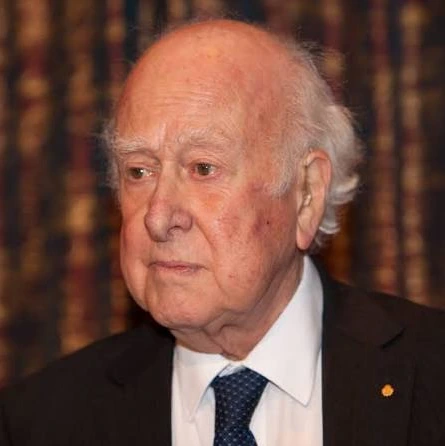
Peter Higgs
1929–2024 · UK
Prize motivation“for the theoretical discovery of a mechanism that contributes to our understanding of the origin of mass of subatomic particles, and which recently was confirmed through the discovery of the predicted fundamental particle, by the ATLAS and CMS experiments at CERN's Large Hadron Collider”
Shared the prize with: François Englert
The discovery
The Standard Model of particle physics describes nature's forces using laws of symmetry, but that symmetry seemed to demand that the force-carrying particles have no mass. The photon, which carries the electromagnetic force, really is massless, and that force reaches far. The weak force, however, acts only inside the atomic nucleus, so its carriers must be heavy.
In 1964 Robert Brout and François Englert in Brussels, and independently Peter Higgs in Edinburgh, proposed a solution: the whole universe is filled with an invisible field. Particles gain mass by interacting with it, and the stronger the interaction, the heavier the particle. The photon does not interact with the field and stays massless. Higgs showed that a “ripple” in the field would be a particle of its own, the Higgs boson.
Finding it took 48 years. CERN near Geneva built the 27-km Large Hadron Collider, where protons collide at nearly the speed of light, and on 4 July 2012 the ATLAS and CMS experiments announced a new particle with a mass of about 125 GeV.
Robert Brout had died in 2011, and the Nobel Prize is not awarded posthumously, so the prize went to Englert and Higgs.
Life
Born on 29 May 1929 in Newcastle upon Tyne, England, he studied at King's College London and earned his doctorate in 1954.
From 1960 he worked at the University of Edinburgh, where he wrote his famous 1964 papers, becoming emeritus professor in 1996. He died in Edinburgh on 8 April 2024.
Where it is used today
Finding the Higgs boson completed the Standard Model, which describes all known particles and three of the forces. If the electron had no mass, atoms could not form, and there would be no stars, planets or life.
The technology built for the search has proved useful too: superconducting magnets and particle detectors developed for the collider are used in medical scanners and cancer radiotherapy, and worldwide computing grids for sharing data grew up here.
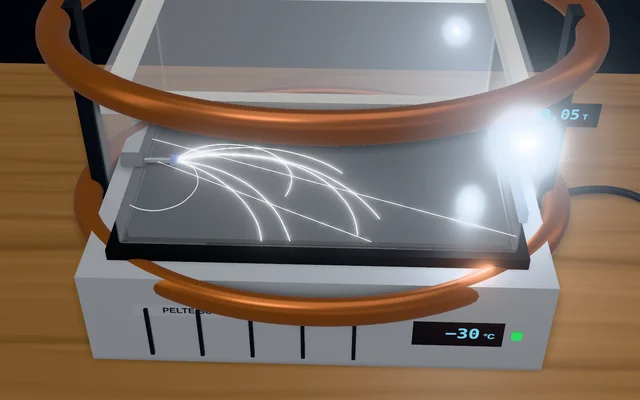 Try it in the labCloud chamber3D lab on this site →Share on Telegram
Sources: NobelPrize.org — 2013