Solar Orbiter spots tiny 'campfires' on the Sun
The probe launched on 10 February 2020 and its first images were released on 16 July. It was 77 million km from the Sun when they were taken.
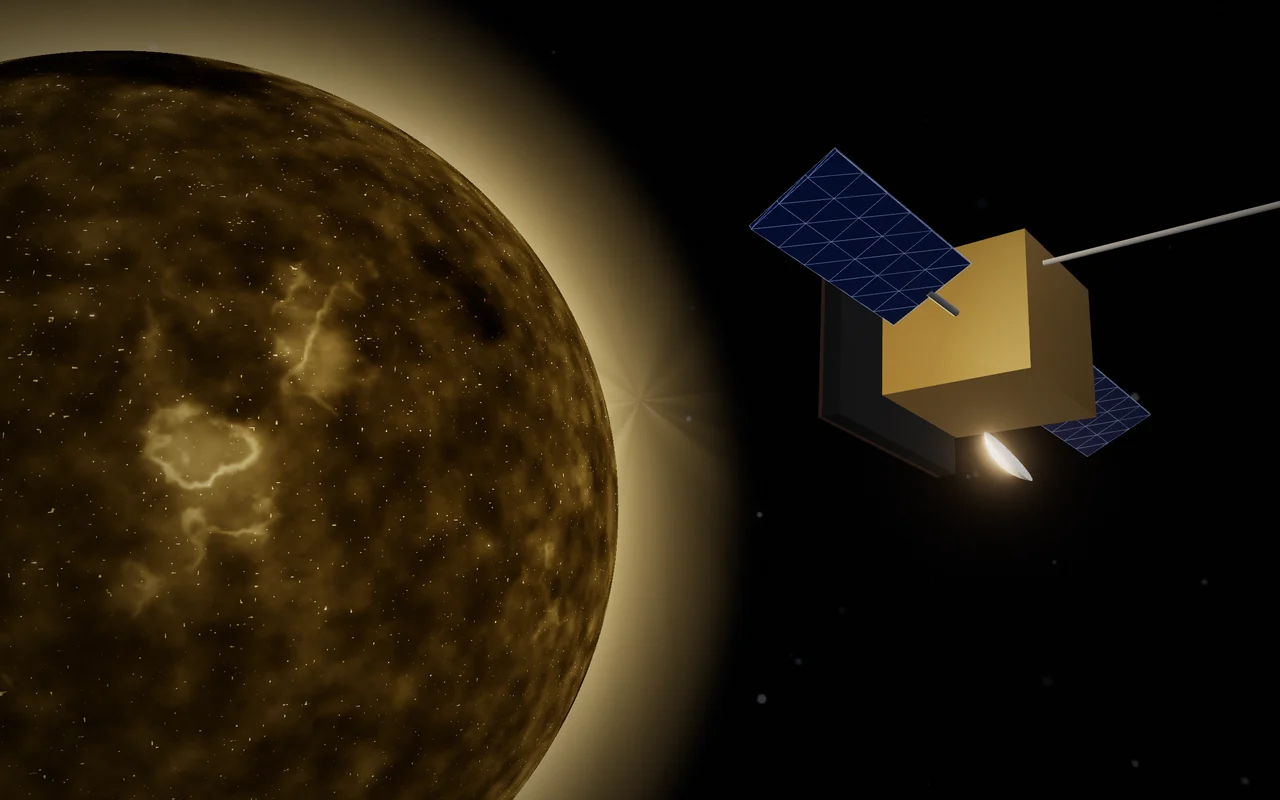
Image: Virtual Lab (3D illustration)
Solar Orbiter is a joint mission of the European Space Agency and NASA, launched from Florida on an Atlas V rocket. On 15 June it made its first close pass of the Sun, at about half the Earth–Sun distance, and tested all six of its telescopes for the first time.
Its extreme-ultraviolet camera imaged the corona, the Sun's outer layer heated to millions of degrees. Bright points from a few hundred to a few thousand kilometres across kept flaring up and quickly fading.
The Sun's surface is about 5,500 °C, yet the corona tops a million degrees — a long-standing puzzle. Scientists suspect the 'campfires' may be the 'nanoflares' predicted decades ago, which could help heat the corona.
Such flares are driven by the Sun's magnetic field: when field lines tangle, snap and reconnect, magnetic energy suddenly turns into heat and motion. In the following years the probe moved closer still, and in 2025 it took the first pictures of the Sun's poles.
 Try it in the labElectromagnetic induction3D lab on this site →Share on Telegram
Sources: ESA · Scientific American