Heaviest neutron star weighed: 2.35 solar masses, spinning 707 times a second
The result was published in The Astrophysical Journal Letters on 26 July 2022, from measurements with the Keck telescope in Hawaii led by Roger Romani.
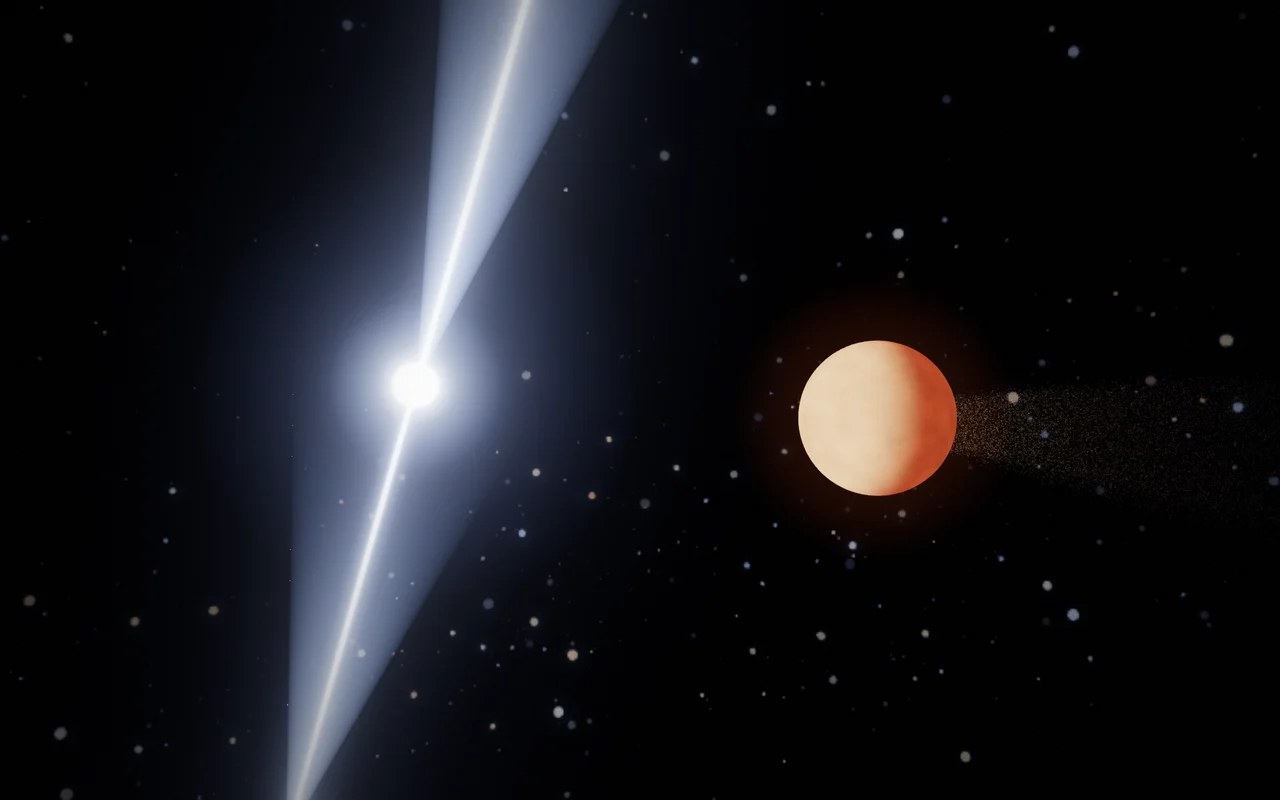
Image: Virtual Lab (3D illustration)
A neutron star is the ultra-dense core left after a massive star explodes: more than the Sun's mass crushed into a ball about 20 kilometres across. Its matter is denser than an atomic nucleus, and how matter behaves at such densities is still not fully understood.
PSR J0952−0607 lies in the constellation Sextans, several thousand light years away. It spins 707 times a second, the second-fastest pulsar known. It was spun up by pulling matter from its companion, and now its intense radiation is evaporating that companion — the hallmark of a 'black widow' pulsar.
Little of the companion is left: about 20 Jupiter masses. The Keck telescope took its spectrum and measured its orbital speed via the Doppler effect. Knowing the orbital period and speed, Kepler's laws gave the pulsar's mass.
Neutron stars have a maximum mass beyond which they collapse into black holes, set by how 'stiff' the matter inside them is. A 2.35-solar-mass star pushes that limit upward, ruling out many theories of neutron-star matter.
 Try it in the labCentripetal force3D lab on this site →Share on Telegram
Sources: Phys.org (UC Berkeley) · ApJ Letters (DOI)