Webb finds a black hole that formed before its galaxy
The results were published on 27 May 2026 in Nature and the Monthly Notices of the Royal Astronomical Society, in work led by researchers at the University of Cambridge.
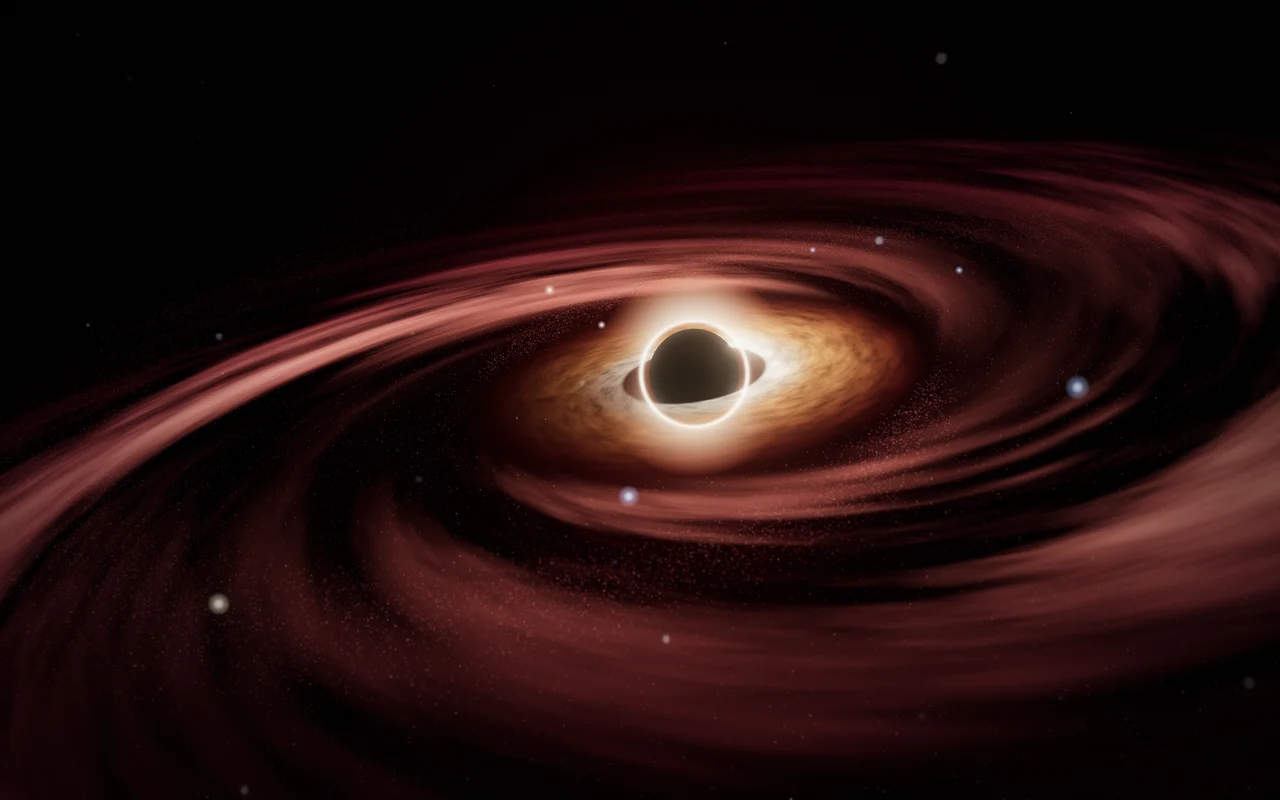
Image: Virtual Lab (3D illustration)
Webb has found hundreds of tiny reddish objects in the early universe, dubbed 'little red dots', whose nature has long been debated. Abell2744-QSO1 is one of them: only 1,300 light years across, at redshift z = 7, its light set out when the universe was 5% of its present age.
It is easier to study than most because the galaxy cluster Abell 2744 in front of it acts as a gravitational lens, magnifying its light and showing it in three places on the sky. Using a special mode of Webb's NIRSpec spectrograph, the team measured the gas velocity at every point and built a velocity map.
The gas orbits the centre just as planets orbit the Sun — following Kepler's law, slower the farther out it is. That means nearly all the mass sits at a single central point. Kepler's law then gave the black hole's mass: 50 million Suns. Until now, black holes in the early universe had only been weighed indirectly, using relations calibrated on nearby galaxies.
The gas is almost pure hydrogen and helium, with less than 0.5% of the Sun's heavy-element content, so hardly any stars have formed there. The black hole did not grow slowly from a dead star; it was huge from the start — perhaps a primordial black hole born in the first second after the Big Bang, or the product of a giant gas cloud collapsing directly. 'It's a paradigm shift, a total revisiting of the classical scenarios of how black holes form and grow,' says Roberto Maiolino of Cambridge.
 Try it in the labCentripetal force3D lab on this site →Share on Telegram