CERN completes the family of doubly charmed particles
On 3 June LHCb announced the new particle at the Beauty 2026 conference in Maastricht.
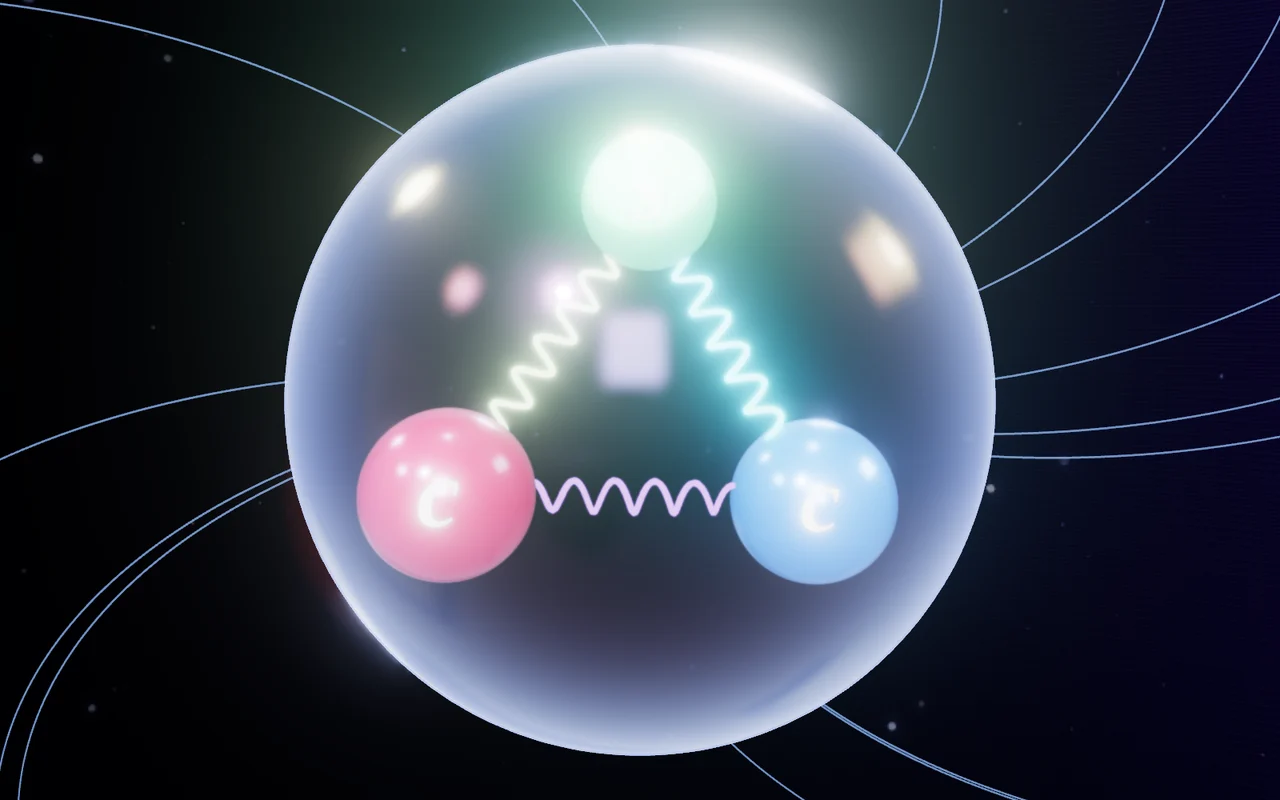
Image: Virtual Lab (3D illustration)
Baryons, like protons and neutrons, are made of three quarks. There are six kinds of quark: up (u), down (d), strange (s), charm (c), beauty (b) and top (t). A charm quark is about 1.3 times heavier than a proton, so particles containing two of them are very hard to make and detect.
After the charm quark was discovered in the 1970s, theorists predicted a family of baryons with two charm quarks, the third quark being up, down or strange. LHCb found the first, Ξcc⁺⁺, in 2017 and the second, Ξcc⁺, in March 2026. Now the last member, Ωcc⁺, has been found too.
The new particle is about four times heavier than a proton and very short-lived, travelling only a fraction of a millimetre before it decays. Scientists do not see it directly but reconstruct it from the tracks of its decay products. The discovery came from 2024 collision data recorded by the upgraded detector.
History repeated itself: in 1964 Brookhaven National Laboratory found a predicted baryon made of three strange quarks, proving the power of the quark model, after scanning some 80,000 bubble-chamber photographs. The new Ωcc⁺ is that particle's “heavy cousin”, with two charm quarks in place of two strange ones.
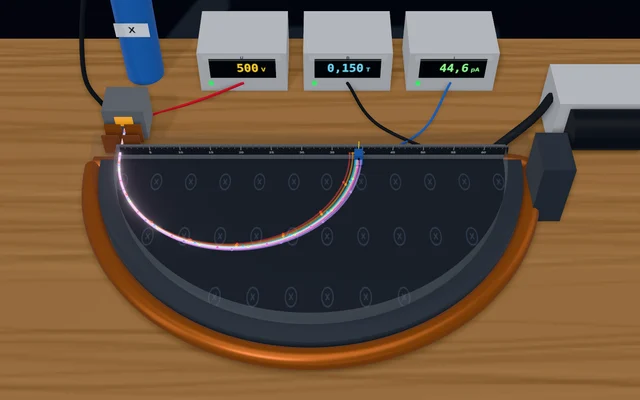 Try it in the labMass spectrometer3D lab on this site →Share on Telegram
Sources: LHCb (CERN) · Nikhef