Home › Nobel Prize laureates › 1996–2005 › 2005
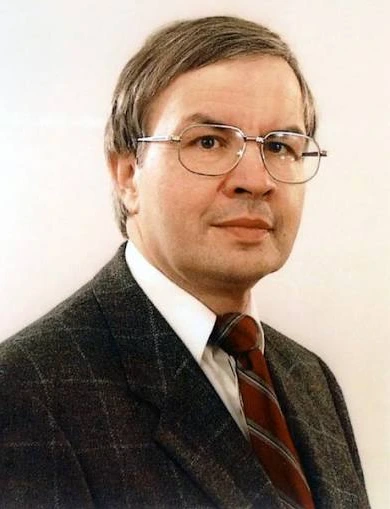
Theodor W. Hänsch
born 1941 · Germany
Prize motivation“for their contributions to the development of laser-based precision spectroscopy, including the optical frequency comb technique”
Shared the prize with: Roy J. Glauber, John L. Hall
The discovery
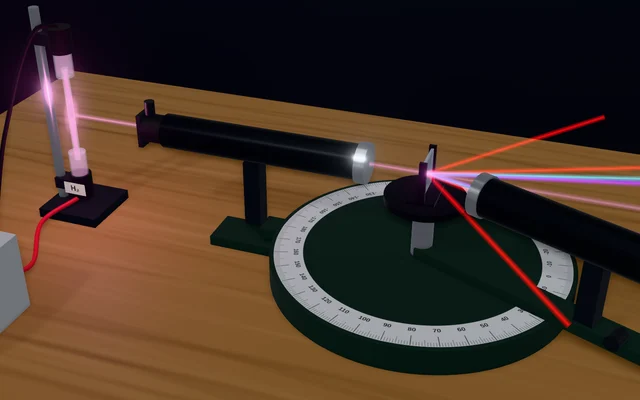
Every atom absorbs and emits light only at its own particular frequencies. These spectral lines are the atom's “barcode”, and the more precisely we measure them, the more accurate clocks become and the better we can test the constants of physics.
The trouble is that the frequency of visible light is enormous, hundreds of trillions of oscillations per second, and no electronics can count them directly. Measuring one used to need complicated “frequency chains” filling a whole laboratory, each able to measure just one frequency.
The optical frequency comb solved the problem. A steady train of ultrashort laser pulses produces thousands of evenly spaced lines in the spectrum, like the teeth of a comb or the marks on a ruler, and comparing an unknown frequency with this ruler measures it to 15 digits.
The idea came from Theodor Hänsch, and in 1999–2000 he realised it in Garching near Munich while John Hall did so in Boulder. Earlier, Hall had developed methods for stabilising laser frequencies and helped redefine the metre in terms of the speed of light.
Life
Born on 30 October 1941 in Heidelberg, Germany, he studied at the University of Heidelberg and earned his doctorate in 1969.
From 1970 to 1986 he worked at Stanford University in the USA, where he became a professor, and since 1986 he has been a director of the Max Planck Institute of Quantum Optics in Garching and a professor at the University of Munich.
Where it is used today
Optical combs are an essential part of the world's most accurate optical atomic clocks, which will underpin a new definition of the second and more precise navigation.
Astronomers calibrate spectrographs with combs to measure the tiny wobbles of stars and search for exoplanets, and combs are also used to analyse gases in breath and to test whether the constants of physics change over time.
 Try it in the labAtomic spectra3D lab on this site →Share on Telegram
Sources: NobelPrize.org — 2005