Home › Nobel Prize laureates › 2006–2015 › 2008
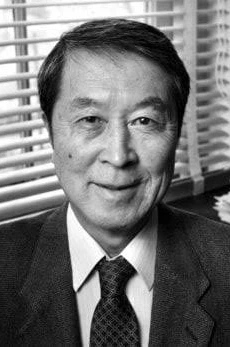
Yoichiro Nambu
1921–2015 · Japan / USA
Prize motivation“for the discovery of the mechanism of spontaneous broken symmetry in subatomic physics”
Shared the prize with: Makoto Kobayashi, Toshihide Maskawa
The discovery
Spontaneous symmetry breaking means that nature's laws are symmetric while the most stable state of a system is not. A simple example is a pencil balanced on its tip: it can fall in any direction, and the law is the same for all of them, but the fallen pencil “chooses” one.
A magnet is similar. In hot iron the tiny atomic magnets point every which way, but on cooling they pick one direction and the iron becomes a magnet, even though the laws favour no direction.
In 1960 Nambu carried this idea from the theory of superconductivity into the world of particles, showing that “empty” space, the vacuum, can itself break a symmetry. This helped explain where the mass of protons and neutrons comes from and why some particles are so light.
Nambu's idea later became a foundation of the Higgs mechanism and the Standard Model of particle physics.
Life
Born on 18 January 1921 in Tokyo, he grew up in Fukui, graduated from Tokyo Imperial University in 1942 and became a professor at Osaka City University in 1950.
In 1952 he was invited to the Institute for Advanced Study in Princeton, USA, and from 1954 worked at the University of Chicago, becoming a US citizen in 1970. He died in Osaka on 5 July 2015.
Where it is used today
The idea has become one of the most general concepts in physics, describing superconductors, magnets, liquid crystals and the first moments of the universe in a single language.
Nambu was also one of the founders of string theory, one of today's attempts to unite all the forces in a single theory.
Sources: NobelPrize.org — 2008