Home › Nobel Prize laureates › 2006–2015 › 2009
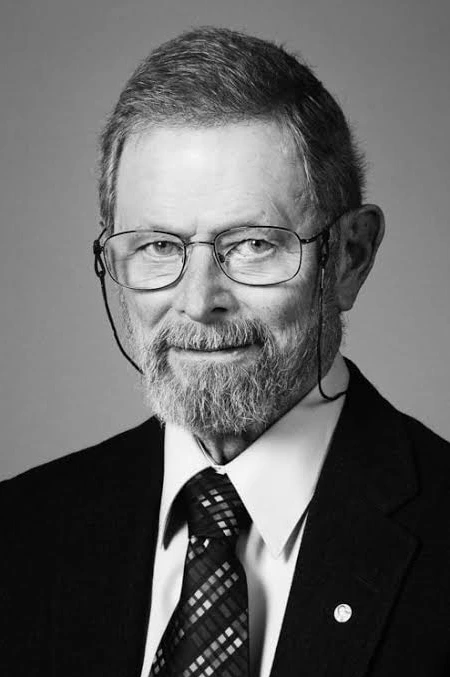
George E. Smith
1930–2025 · USA
Prize motivation“for the invention of an imaging semiconductor circuit – the CCD sensor”
Shared the prize with: Charles K. Kao, Willard S. Boyle
The discovery
In 1969 at Bell Laboratories in the USA, Willard Boyle and George Smith sketched an idea for a new electronic memory on a blackboard in less than an hour. It soon turned out to be much better at capturing images than at storing data.
A CCD relies on the photoelectric effect explained by Einstein: light striking a silicon chip knocks out electrons. The sensor's surface is divided into millions of tiny cells, or pixels, and each pixel collects electrons like a little bucket, so the more light falls on it, the more charge it gathers.
The charges are then passed row by row from cell to cell, like buckets along a chain, and measured at the edge. Each charge becomes a number, and the numbers build the picture, which is where the name “charge-coupled device” comes from.
In 1970 Boyle and Smith built the first CCD video camera. Astronomers adopted CCDs quickly because they were tens of times more sensitive than photographic film.
Life
Born on 10 May 1930 in White Plains, New York, USA, he served in the US Navy, then graduated from the University of Pennsylvania and earned his doctorate at the University of Chicago in 1959.
From 1959 to 1986 he worked at Bell Laboratories, heading a microchip device department. He died in New Jersey on 28 May 2025.
Where it is used today
CCDs launched the era of digital photography. Phones today mostly use a different kind of sensor, CMOS, but it rests on the same ideas of the photoelectric effect and pixels.
The Hubble Space Telescope, Mars rovers and many observatories use CCD cameras, and in medicine they are used for X-ray imaging and endoscopy.
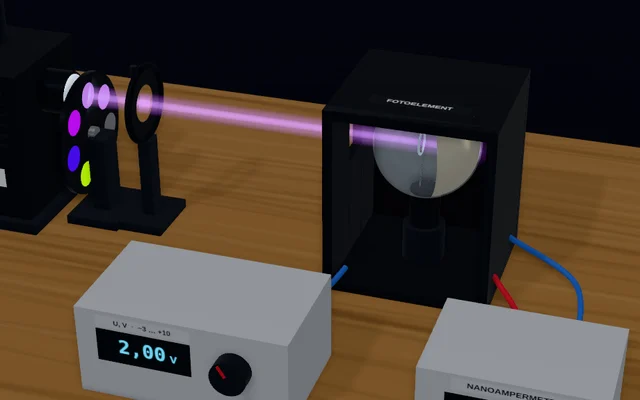 Try it in the labPhotoelectric effect3D lab on this site →Share on Telegram
Sources: NobelPrize.org — 2009