Home › Nobel Prize laureates › 2006–2015 › 2010

Andre Geim
born 1958 · Netherlands / UK
Prize motivation“for groundbreaking experiments regarding the two-dimensional material graphene”
Shared the prize with: Konstantin Novoselov
The discovery
Graphene is a single layer of carbon atoms arranged in hexagons like a honeycomb, just one atom thick. The graphite in a pencil is millions of such layers stacked together. For many years theorists believed such a thin layer could not exist on its own.
In 2004 at the University of Manchester, Andre Geim and Konstantin Novoselov used ordinary sticky tape to lift thin flakes off graphite. Sticking and peeling the tape again and again, they got down to a single atomic layer. Placed on an oxidised silicon wafer, the graphene became visible in an ordinary microscope thanks to light interference.
Graphene's properties are astonishing. It is almost transparent, absorbing only 2.3% of light, about 100 times stronger than steel of the same thickness, and conducts electricity better than copper. Its electrons move as if they had no mass, and not even helium, the smallest gas atom, can pass through it.
Geim's lab had a tradition of “Friday evening experiments”, trying out unusual ideas alongside the main work, and graphene grew out of one of these games.
Life
Born on 21 October 1958 in Sochi, he graduated from the Moscow Institute of Physics and Technology in 1982 and earned his doctorate at the Institute of Solid State Physics in Chernogolovka in 1987.
He worked at universities in the UK and Denmark and from 1994 at Radboud University Nijmegen in the Netherlands, and has been a professor at the University of Manchester since 2001. A Dutch citizen, he was knighted in the UK in 2012.
Where it is used today
Graphene is being tried in touch screens and flexible electronics, light and strong composites, sports equipment, batteries and supercapacitors, and graphene membranes are being studied for removing salt from water.
Graphene opened the way to a whole family of two-dimensional materials such as boron nitride and molybdenum disulfide. In 2018 two layers of graphene twisted at a “magic angle” were found to become a superconductor.
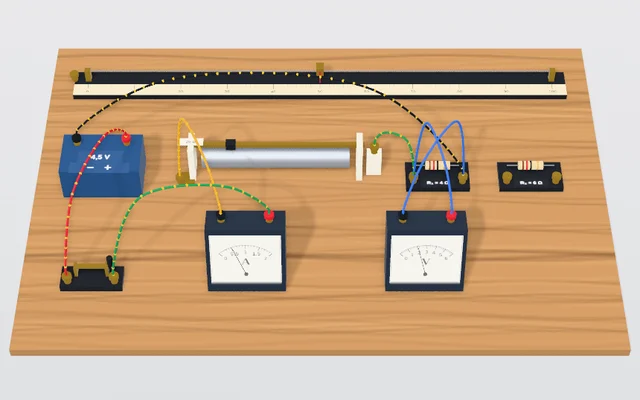 Try it in the labOhm's law3D lab on this site →Share on Telegram
Sources: NobelPrize.org — 2010